Wednesday, October 10, 2007

Breaking Monopolies of Local Power

By: Gladstone A. Cuarteros / IPD
October 11, 2007


Among the most dominant frameworks in Philippine politics is the patron-client perspective, advanced in the 1960s by Carl Lande. It emphasizes the highly personalized, multifunctional social relations defined by dyadic bonds of reciprocity and mutual obligation between two individuals with different level of wealth and influence. The patron is expected, through the use hi
s/her wealth and influence, to provide protection and material well being to the lower status client and his family who in return reciprocates by offering general support and assistance including personal service to the patron.1 The framework assumes a harmonious relationship between the patron and the client, an assumption highly criticized because it gives insufficient consideration of the inequality between them.

Closely related is faction or family/clan framework. It also recognizes the reciprocal exchange like the patron–client relation, but it focuses more on the organizational vehicle for political mobilization. Taking off from the Lande
’s conclusion that political parties in the Philippines are devoid of significant differences, they argue that politics can be more characterize as competition among groupings/factions or family constellations. McCoy (1996) furthered this by insisting that it is more appropriate to understand local politics by looking at elite families. According to him, it is the interest and motivations of the elite that shapes the politics. While McCoy acknowledges the use of patron-client as strategy, he also pointed out that elite families likewise use violence and engage in rent seeking in order to maintain or gain dominance.

Earlier research works of the Institute for Popular Democracy (IPD) have utilized political clan as its framework. Guiterrez, et al (1992) ‘believes that clan remains politics remain the most decisive influence in shaping it
s nature and character’. The power relations and decision making continues to be ‘determined by the motions and dynamics of political clans. In the book ‘All in the Family’, it was found that about fifty-six percent of the winners in the 1988 local elections came from old political clans and their relatives while thirty-two were new contenders. In the succeeding study on the members of the House of Representatives, the situation was more elite domination with seventy-two percent belonging to political families (Gutierrez, 1994). The elected local positions seem to have more room for new comers.

Recognizing the role of coercion and violence is something McCoy shares with John Sidel (1997, 1999). Both scholars have noted the longevity and resiliency of local families, however Sidel do not attribute this only to the use of violence and coercive forms of control over the population but also the decisive role of state structures. He says these two factors facilitate the emergence and entrenchment of local bosses. Control of the state apparatus will allow their hold on coercive violence and provide opportunity to gain more economic resources. Sidel explains what he means by boss
es/bossism.

“By ‘bosses’… refers to the predatory power brokers who achieve monopolistic control over both the coercive and economic resources within the territorial jurisdiction or bailiwicks. Bosses thus include para- statal mafias, small town mayors, provincial governors and even presidents. By ‘bossism’ .. alludes to that sophisticated system of brigandage and interlocking multi-tiered directorate of bosses whose control over the state apparatus facilitates their exploitation’s human and natural resources.”

The emergence of political machine comes from the eroding influence of patron-client relationship that has characterized Philippine politics for a long time. It is claimed that as consequence rapid urbanization, decreasing importance of land as the major source of surplus for the local elite, expansion of mass media, ritual kinship ties no longer key to defining political alliances, political machines are replacing family/clans. The ‘professional politicians will also be replacing landlords and traditional politicians who could only provide part of their time in politics (Machado,
1974).

Also common consensus among scholars is the strong-oligarchy, weak-state thesis. There is patrimonial plunder of the state resources. The oligarchy has a blurred sense of what are public goals from personal goals and so they utilized the state apparatus to advance their own personal interest. Hutchcroft (1998) detailed how booty capitalism under a patrimonial oligarchic state was undertaken in the banking sector. The state has given in to the pressure from powerful bankers, because
in the first place the country has inherited weak state institutions from its colonial past. Advocates of the strong oligarchy, weak state argument, locate the ‘democratic deficit’ from the haphazardly organized local governments established during the American’s benevolent assimilation. The colonial goals of controlling the country permitted the local elite to invade the state resulting in a lesser ‘state autonomy’.

From the above discussion, we obs
erve two major segments of scholarship complementing each other. Most studies are elite-focused whose findings show enduring elite domination. The other prefers highlighting the weakness of the Philippine state which provide opportunity for predatory oligarch to continue of their patrimonial plunder. Elite-focused studies emphasize so much on role of political actors, especially the dominance the ruling elite holding influential positions while those sort of ‘statist’ stresses the weakness and misgivings of the Philippine state tracing it back to the weak institutions bequeathed from the Americans after independence. While these explanations are correct, an area left unattended, however, is explaining the successful entry of new actors mediated through regular elections. We indicated above that the other side of the coin is the twenty to thirty-five percent new entrants in politics. If traditional political families do fall from their position of advantage, the underlying analytic is under what conditions does it happen and how do new political actors become successful in wrestling power from them.

In studying how less-than-democratic elections could contribute to democratization both under an authoritarian regime and under a clientilistic electoral regime immediately after authoritarian regime's collapse, Franco5 argued that less-than-democratic elections under an authoritarian regime could contribute to democratization if it can create political space for democratic opposition to emerge against the authoritarian rule. Elections primarily called to give legitimacy to the power holders are transformed into political opportunities for the democratic opposition.

On the other hand less- than-democratic elections under a clientilistic electoral reg
ime can further erode authoritarian obstacles to democratization when: one, regional (local) authoritarian elites are either divided or isolated from allies at the national level; two, the democratic opposition is united electorally; and three, there is pre-existing alternative outreach network that enhances political capacity of previously unrepresented groups during and between elections. In the background of her argument is the fact that collapse of authoritarian regimes at the national level does not necessarily mean democratization system-wide. There remains authoritarian enclaves at the provinces and municipalities that hamper conduct of competitive, meaning free and fair, elections at the local level. She cited examples of countries in Latin America and the Philippines where competitive national elections did not mean end of authoritarian practices system-wide. In these countries local elections are controlled by local bosses who among others, have no qualms of employing intimidation and violence.

Franco's main contribution in the literature of local politics is her identification of the conditions surrounding the collapse of regional authoritarian enclaves even under a clientilistic electoral regime. She, however assumed that the democratic opposition do not have links with another set the national elite, or at least linkage with a national personality. On the contrary it helps the candidate of the democratic opposition when he/she have linkage with national elite or personality. Secondly, although she noted the role played of the activist media in the case of the second congressional district in North Cotabato, Philippines in 1987 elections whose activist reporting prevented the local authoritarian elite to rigged the outcome of the elections, she failed to highlight the media's role. An activist media6 that regularly broadcast or publish developments/updates regarding an electoral contest not only provides information to grassroots supporters of the candidate from the democratic opposition so that these supporters can mobilize and troop to the canvassing area if need be, but more importantly an activist media makes the candidate of traditional political families to think twice before employing intimidation, violence and/or cheating in order to influence the election outcome.

While in this paper we validate the significance of the three conditions identified by Franco, the argument we want to pose is their presence is insufficient to cause the collapse of entrenched political families who most of the time employ authoritarian practices. As the following discussions will show show, it is likewise necessary for the candidate of democratic opposition to have linkages to a section of national elite, and second for media to have an activist role, instead of just delivering the news and information.

The Case of Governor Grace Padaca in Isabela, Philippines
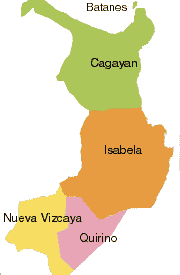
The province of Isabela is located up the north of the Philippines. It is the second largest province in terms of land area bounded by Cagayan province in the north, provinces of Nueva Vizcaya and Quirino in the south, provinces of Ifugao, Mountain Province and Kalinga in the west and the Pacific Ocean in the east. The eastern part straddled by the Sierra Madre mountain range is rugged and thickly forested. A substantial portion remain unexplored hinterlands home to rich variety of fauna and flora, while others are government reservations. The province is criss-crossed by three river systems, namely, Cagayan river, Siffu river and Magat river, allowing it to host a big water dam providing electricity and irrigation of the low-lying plane areas.

It is primarily an agricultural province with an estimated population now
of 1.4 million inhabitants. Isabela is dubbed the 'rice granary of the North' since it is one of top rice producing provinces. It was created by virtue of a Royal Decree issued on May 1, 1856 delineating its territory out of the provinces of Cagayan and Nueva Vizcaya. The creation of a separate province was to facilitate the work of missionaries in the evangelization of the Cagayan Valley Region. The province was named in honor of Queen Isabela II of Spain, which colonized the Philippines until 1898. It is now composed of 34 municipalities and 3 cities, with Ilagan City as its provincial capital.
For more than thirty years the province is under the administration of the Dy family. It started when the patriarch of the family, Faustino Dy Sr. was elected provincial governor in 1969. Immediately before that, he served first as Cauayan municipal mayor for four years. Since 1969 Faustino Dy Sr. went on to serve as governor until 1986 when the Marcos dictatorship was toppled. A known Marcos supporter he was briefly replaced by an Officer-in-Charge during the initial years of President Corazon Aquino who succeeded Marcos. At that time President Aquino tried to dismantle the control of traditional political families especially those identified with the dictatorship. But Faustino Dy Sr. soon was re-elected again in the 1987 local elections right after ratification of the new Philippine Constitution. Faustino Dy Sr. served until 1992 and later asked his son Benjamin Dy to replace him. In 1993 Faustino Dy Sr. died but his son Benjamin continued the hold of the family in the province. Benjamin served for nine straight years. He was forced to pass the governorship to his half-brother Faustino Dy Jr. in 2001 because he was no longer qualified to run for yet another term.

Faustino Dy Jr. himself is not a political neophyte when he ran for governor in 2001. He had represented the second district of the province in the House of Representatives for three terms or nine years. The other members of Dy clan also occupied, and are until now occupying other local positions. (larwan: Gov Faustino S. Dy, Jr. / www.lpp.gov.ph/govs/dy.jpg)

Thus practically members of Dy family are taking turns in controlling the provincial government. But seemingly not contented they are also actively expanding control by contesting other legislative and municipal mayor positions. The clan is so strong and influential that attempts to go against them have failed and usually after elections, the losing challengers are effectively neutralized.

2004 and 2007 Gubernatorial Elections

Grace Padaca got her revenge in 2004 elections when she and then incumbent governor Faustino Dy Jr. squared it off in the elections. In that year elections was for national positions (President,Vice President and Senators) as well as for local positions (legislative district representative, provincial governor, vice -governor, provincial board members, municipal/city mayors and vice mayors ; and municipal/city councilors). For the position of provincial governor Dy was seeking re-election while it was only Padaca who challenged him. According to Dy political operators the governor was confident that he will easily defeat Padaca since the lady does not have the machinery, money and influence14. Besides Faustino Dy Jr. believes that he performed well delivering on services that the people needed.

For Padaca she said she decided to run again in 2004 because the people clamored for change. Recalling her experience in the 2001 election she repeatedly indicated in her media interviews that the greatest pressure was when people told her to continue fighting because they are also fighting for her. In one media article she was quoted “ the people of Isabela were not given a chance to choose, instead we were just being made to perfunctorily write their names in the ballot to legitimize their positions. It came to a point that even a dog can win in an election for as long as it is supported by the Dy family, proof of their power'.

She was also encouraged by other local political and business elites in the province who tried to challenge the Dy's but were unsuccessful. What came easily handy advantage for Padaca's is her clean reputation as a broadcaster where 'she refused bribes from sources and returned their gifts even on Christmas16 and thus she was the candidate of sectors such as the peasants, middle class and the Church. Someone who can give the people an alternative. Lacking with the resources she tapped on these groups to assist in her campaign. Padaca then went on to win as governor with a margin more 44,292 votes over her rival.

This year 2007 she repeated her victory on her third-round bout with the Dy family. This time she defeated Benjamin Dy, the former governor who had occupied the post from 1992-2001. While her electoral margin in this election is lower relative to 2004, what are the conditions that allowed her to wrestle control of the province from the Dy? How did she sustain her victory?

The Local Elite
Isabela have at least six big political families but with the Dy as the most dominant. They are all traditionally active in local politics. While at some periods in history they become rivals, but nevertheless for the last three decades they somehow have manage to divide the positions among themselves. The Dys would get the governor and third district representative; the Albano's would be representing the first district, the Uys would get the second district and alternately the Miranda and Aggabao would represent the fourth district. Usually these families would align with one another depending on their own political interest. In 2004 election Faustino Dy Jr. was also supported by the Aggabao and Albano's clans while the Uy's and Miranda families supported Padaca.

In terms of party affiliation Faustino Dy Jr. was the president of the Nationalist People's Coalition (NPC), a party founded by businessman very close to Marcos Mr. Danding Cojuangco. Mr. Cojuangco chairs the San Miguel Corporation which is the largest food conglomerate in the country. The Albano family are members of Lakas-Christian-Muslim Democrats (Lakas-CMD). Part of the alliance of Dy and Albano is the formal alliance between NPC and Lakas-CMD at the national level. Representative Edwin Uy of second district is also a member of Lakas-CMD but because the party alliance was just loose and more directed on the presidential contest, Uy opted to support Grace Padaca. Secondly the Uy's are rivals of the Dy's.

The Aggabao are rivals of the Miranda's in the fourth district. Aggabao is a also a member of NPC while Miranda was with the Partido ng Masang Pilipino (PMP). Aggabao supported Dy while Miranda went for Padaca. Thus the alignment the local political elites was such that Dy-Albano-Aggabao families on one side while Uy-Miranda on other side. Clearly while Dy is the only elite candidate for governor, not all the ruling political elites in Isabela province are behind his candidacy.

Because 2004 was also a presidential election alignment with national elite was all the more important. Through this alignments resources can be accessed and networks can be expanded. Dy as member of the NPC is supporting President Gloria Macapagal Arroyo who was running her own full six year term. She has formed K4 coalition composed of half of NPC, Lakas-CMD, Liberal Party and PDSP. On the other hand Padaca was running under smaller Aksyon Demokratiko Party whose presidential standard bearer was former senator Raul Roco. Roco was at first leading in presidential survey but in the middle of his campaign it lost steam and strategy. He finished fourth among the five presidential candidates. But nonetheless the linkage of local candidates to national elites proved critical later on in the canvassing and proclamation of the winner.


It took more than a month before Grace Padaca was finally proclaimed as the winner in the 2004 elections. The Dy camp successfully delayed the canvassing of votes by filing a series of pre-proclamation cases that the Provincial Board of Canvassers have to give due course by setting a hearing and promulgating a decision. It was further delayed when Dy even appealed PBOC decisions to the Comelec en banc at the Central Office.

There were attempts to manipulate the election outcome. But the vigilance of Padaca's supporters who have taken turns in coming to the capitol compound where the canvassing is held prevented execution of any special operations by the Dy camp. Fortunately the local Comelec registrar brought home with him the certificate of canvass (CoC) which he was able to deliver to the provincial capitol.

Another attempt was when the canvassing was on-going in the provincial gymnasium at the capitol compound, there was also an attempt to effect a brownout. Again the perpetrators allegedly linked with the Dys committed a mistake by cutting-off electricity in the capitol building instead of the adjacent gymnasium.

When the canvassing process was getting delayed presidential candidate Raul Roco traveled to Isabela to give direct support to her partymate Grace Padaca. His visit provided additional national media attention on the case of Isabela which taking a long time to proclaim its governor. Finally after a long wait Grace Padaca was proclaimed winner in the electoral contest by June 15, 2004 when Comelec en banc dismissed the remaining issues raised by Dy. Our interviewees for this paper revealed that Roco before conceding to Gloria Macapagal Arroyo in the presidential contest have specifically asked the President to request Comelec to proclaim Padaca. Comelec is supposed to be independent from the President but informations like this are not surprising in the Philippines because its democratic institutions are generally weak.

Ironically the nine towns are in the area of the Albano's who shifted their support to Padaca when Dy substituted the candidacy of Faustino Dy Jr. with that of Benjamin Dy. Apparently Dy and Albano families had a unity pact where Tonypet Albano will not pursue running for governor but instead support the attempt of Faustino Jr. to reclaim his old post. But instead Benjamin Dy who ran. Feeling betrayed by the last-minute substitution, the Albano's then lend their political machinery to Padaca and campaigned for her.


For the 2007 election Padaca ran under the Liberal Party (LP) headed by ex Senate President Franklin Drilon. LP was the declared by Comelec as the dominant opposition party, allowing it to receive the 6th copy of the certificates of canvass from the Comelec. During the delays in the canvassing and proclamation, the LP held a press conference in Manila urging Comelec to dismiss the petition to declare failure of elections in district one. Drilon chided the compliant because the same election returns (CoCs) that were petitioned for exclusion in the canvassing are the ones used by Comelec in proclaiming Rodolfo Albano Jr. as the duly elected representative. The LP then asked “ while the election returns were valid in so far as Congressmen Albano and the vice governor are concerned, it became questionable when it came to Governor Padaca?”

On June 28, 2007 Padaca was finally proclaimed winner. She received 235,128 votes while Dy got 220,121 votes or a lead of 17,007 votes.

The United Opposition
A second condition necessary in the collapse of traditional political clans is that democratic opposition should be united electorally. In this case there is unity within the ranks of the broad democratic opposition. For the first time in four decades that a United Opposition emerged in Isabela, all rallying behind the candidacy of Grace Padaca. The democratic opposition was not limited to organized left and progressive groups but instead a mix of some local elite and businessmen, progressive party-list, religious sector and sectoral formations. Thus Congressmen Edwin Uy of Lakas-CMD; Pempe Miranda of the Partido ng Masang Pilipino and Akbayan, Bayan Muna, Gabriela and Anakpawis were part of the United Opposition.


Sectoral groups were the peasants belonging to the Danggayan Ti Mannalon Dagiti Isabela or DAGAMI ( a peasant federation); youth volunteers and students, the Catholic Church as well as Protestant denominations have also lend support to her candidacy. DAGAMI is said to be strong in the forested area of the province and is organizationally present in more than half of the 37 towns and cities of the province. In terms of mobilizing capacity it was observed that DAGAMI can mobilized as much as two thousand farmers, clearly showing a strong organization.


To the businessmen the continuing reign of the Dy's would further deprived them of economic opportunities. Most of the businesses in the province are either controlled by the Dy family or their allies. For example the distribution of San Miguel products from beer to soft drinks, poultry and even dairy products in the entire region are in the hands of the Dy. They are also involved in local hotels and inns (Dy owns the Isabela Hotel), aside from control of the trucking services that brings out from Isabela thousand tons of rice and corn to Manila and Bulacan. Mr. Danding Cojuangco in had an ingenuous of way of keeping loyalty of local political families from the provinces by giving them franchise of the distribution of San Miguel products in their local territories.


The masses were obviously for Padaca. The peasants were complaining of rampant land grabbing during the reign of Gov. Faustino Dy when he introduced contract growing of cassava to be supplied to San Miguel Corporation chaired by Danding Cojuangco. According to documents, the targeted area is as much as 220,000 of land to be cultivated with cassava. Affected towns were Mallig, Quezon, Quirino, San Mariano, Benito Soliven, etc. who are traditionally areas with rice and corn. The actual area did not even reach a thousand hectares since the project failed to take-off with resistance of the farmers until Dy lost in the election and replaced in the provincial capitol.


Other issues like continued logging while there is a logging ban in the whole Cagayan Valley Region were raised against Dy. Also his approval of mining was likewise disapproved by the people and the Bishop of Ilagan Diocese. On top of it all is the unabated jueteng in province despite the serious campaign from the Church to get rid of the illegal numbers game.


Because of the broad support she is getting from organized peasant and other sectors one issue raised against Padaca is the support given to her by the New Peoples Army (NPA) the armed group of the Communist Party of the Philippines. Her opponent Faustino Dy Jr. in one media television interview, reasoned out that 'what happened was, this Ms. Padaca is from the media and she is being used by the NPA. She is the candidate of the NPA and of the church”. Padaca denied she is being used by the NPA. In fact she said that she berated the NPA and CPP during the canvassing in 2001 when they express support for her, deploring the cheating that was done by the Dy's when throughout the campaign CPP-NPA were very silent. They did not support her in the campaign.


Alternative Outreach Network

Isabela has years experience of community organizing most of which were made through programs of the local Catholic Church, the protestant denominations as well and the development non-government organizations which implemented various kinds of economic and social programs. Part of the Church evangelization is the formation Basic Christian Communities (BCC) where youth and adult alike though in reality it is primarily the youth, were thought of catechism. In general the BCC is Isabela were more conservative compared to those in new diocese in Mindanao where the work of BCC highly influenced by liberation theology. Nonetheless the BCC made contributions in developing lay leaders. Protestant churches had their own parish organizing. Depending on the sect they belong they formed organizations for the children, youth and adults. Similar with the Catholics the formations of the Protestants was primarily to facilitate church related activities and programs and in the process develop leadership among the lay people. These experiences in organizing made easier mobilization of the parishioners aimed at protecting and safeguarding peoples right to vote.


How did the Church help Padaca? The Church has dissuaded PPCRV from openly campaigning for Padaca since PPCRV should remain non-partisan but their presence in the precincts and during the canvassing prevented the resorting to tactics of electoral fraud. Secondly, the Diocese of Ilagan opted not to endorse a candidate but Bishop Utleg issued a pastoral letter advising the flock on how they will choose the candidate to vote for governor. In the pastoral letter the Church told the people not to vote for candidates who are involved in land grabbing, who are supportive of mining and those suspected of protecting jueteng lords. Although it didn't directly endorse Grace Padaca the fact that is enumerated the very issues raised against Faustino Dy Jr. it served as an indirect endorsement.


Non-government organizations have organized peoples organizations in the communities for specific issue-based advocacies, most notable of which is the struggle for agrarian reform and rural development in the province. The DAGAMI peasant federation for example increased awareness of the people on economic and social issues in many town of the province that it was easy to mobilized them in electoral advocacies. There were also a number of women and indigenous peoples federations. But in addition to these sectoral organization the party-list groups which supported Padaca like Akbayan, Bayan Muna, AnakPawis and Gabriela have their respective provincial and municipal chapters that continuously recruit new members in their respective areas. These local chapters of the party-list groups also formed the backbone of their own campaign machineries during elections.


Activist Media

The case of Grace Padaca in Isabela in 2004 and 2007 reflects the crucial role of an activist media. Activist meaning media practitioners not limited to their 'traditional role of being mere observer and reporter of events but of a activist role of watchdog and participant in the electoral process'.

The Dy versus Padaca is a classic David versus Goliath fight. The former considered as the Goliath being the new patriarch of the Dy political clan who has behind his back more than three decades of political control in the province. Not to mention the physical and financial resources at his disposal. The latter is regarded David because of her disadvantages in resources, machinery and influence with ruling national elite. It is no wonder then that their fight captured broad local and national media attention.

In both 2004 and 2007 elections Isabela local politics generated greater media focus. The major dailies like the Philippine Daily Inquirer and Philippine Star almost have daily news articles updating on the developments in the Isabela electoral contest. News magazines like Newsbreak and web-based Philippine Center for Investigative Journalism also came up with several interesting articles on the Dy-Padaca fight. Recently this year the Philippine Daily Inquirer had it in its editorial, Proclaiming Grace.22 The local broadcast media kept the people informed of the progress in the electoral contest.

The visit of then presidential candidate Raul Roco during the stand-off in the canvassing of votes at the provincial gymnasium in 2004 boosted the media attention on Padaca's fight of Goliath. With newsmen accompanying Roco the new spread to a broader public and made people throughout the country aware of the issue. The same is true in 2007 when the Liberal Party held a press conference complaining of the delay in Padaca's proclamation.

So much media attention did not come without repercussions though. On the eve of election day in 2004 Bombo Radio was ordered closed down by Comelec. It was then Commissioners Rufino Javier and Virgilio Garcillano23 who signed the closure order alleging that the radio station is engage in partisan campaigning. Actually it was the third time Bombo Radio was closed down that year ostensibly because it failed to get a business permit in Cauayan City where Dy's brother Ceasar was the city mayor.


Of course Padaca being a 14-year broadcaster herself might have the support of her former colleagues. Beyond that however is the feat of wrestling local control from an enduring and well-entrenched political dynasty.

-----------------/////------------------

Struggle of Communication Workers of the Philippines (re PLDT union's struggle against job contractualization)

Bunga ng sangkatutak na kadahilanan, panloob at panlabas na salik, mukhang nagbabago na ang konteksto, character, hugis ng trade unionism, labor movements sa bansa. Ang kasalukuyang dinaranas ng mga manggagawa sa Pilipinas ay halos pinagdaanan na rin ng mga manggagawa sa Kanluraning Europa at Amerika may dalawang dekada (70s-80s) na ang nakalipas.

Pati ang uri ng kilos protesta't pakikibaka, nagbabago na rin. Ang isang malaking katanungan, tatagal pa ba't mag-survive pa kaya ang uring manggagawa sa Pilipinas?


- Doy Cinco / IPD
Oct 11, 2007
--------------------------------------------------
Securing Jobs in the ERA of Contractualization: Implications of the Mass
Dismissals at PLDT

Founded on November 28, 1928, Philippine Long Distance Telephone Company (PLDT) is the leading telecommunications provider in the Philippines. Through its three principal business groups – fixed line, wireless, and information and communication technology – PLDT offers the largest and the most diversified range of telecommunication services across the Philippines' most extensive fiver optic backbone and fixed line, cellular and satellite networks.

From a net income of P28 billion in 2004, income grew by P34.1 billion in 2005 and P35.1 billion by 2006. In the first six months of 2007, net income already reach P17.0 billion.

By 2004, the company's top brass who made P150,000 / month, got additional perks amounting to P1.0 million. The windfall included fifteen thousand share of stocks worth P9.0 million. They are now worth P39.0 million.

Diversification of services upped the requirement in manpower. This doubled the rank and file workers from 15,000 in 1997 to the present 30,000. A closer look revealed that the numbers of regular (and unionized) employees actually shrank dramatically.

How was this possible? PLDT offered 'juicy' early retirement packages (ERP) and gave vacated the positions to sub-contracted employees or 'spin-offed' to subsidiary companies owned by PLDT such as E-PLDT, VENTUS, PARLANCE.

Management got the same services for less via contractualization. At the same time denying regularly- hired workers the job (result: redundancy). In the case of PLDT, where the CBA protects the tenure of regularly hired employees by providing for job transfer, it also narrowed the employees' option for transfer to other PLDT jobs if and when they are threatened with dismissals through redundancy.

---------------

A weaker union and a predominantly contractual workforce set the stage for PLDT's plan of 'manpower reduction'.

By December 2002, 385 employees including two union officers were axed. Before the strike could break out, then Labor Secretary Patricia Sto. Tomas immediately assumed jurisdiction over the dispute issued and a return to work order to the striking workers and a no lock-out oder to the company, except towards those facing dismissal. The union contested the decision and got a favorable ruling by 2005 fronm the Supreme Court.

At the National Labor Relations Council (NLRC), the union filed a case of unfair labor practices against the PLDT Management for its violation of the above-mentioned provisions of the CBA. The case unfair labor practice against the PLDT management is still being heard by the Court of Appeals.

Yet, despite the union's victory in the first case and the pendency in court of the second case, 575 workers including 25 union representatives were terminated effective September 15. This time, the bulk of affected were women, some single mothers and breadwinners that gave 15-20 productive years in a company eager to throw them over like yesterday thrash.

Fighting The Grim Future of Labor
Recently, the Department of Labor and Employment (DOLE) said the strikes are down to three in the past nine months. Far from being an indicator of budding industrial peace, lack of strikes is proof that the Assumption Jurisdiction Order is now a weapon for suppression and eventual union-busting rather than the first step towards mediation. It allows brazen companies like PLDT to do as it pleases while forbidding the union to take action in return.

Along with contractualization, problem arising from AJ are problems faced by the organized section of labor. Job security and the concomitant right to organize and bargain collectively are at risk. Firms like General Milling and Robina Farms where the ratio of regular workers to contractual workers rendered the union inutile, losing its capability to defend and assert workers' rights and interests.

The struggle of Mangggawa sa Komunikasyon ng Pilipinas (MKP), the rank and file union is a struggle for itself and for its class. Concretely, it is a bid to secure the future of labor in an era of further 'flexibilization'-- a mss of casuals moving as free as capital, voice-less, unorganized and equally free to be exploited by capitalists. As one of the few surviving national unions in the labor scene today, all eyes are on PLDT as the outcome would surely set a precedent. ------/////-------

Communication Workers of the Philippines
c/o 22 Libertad st., Mandaluyong City
Tel.Nos: (02) 5310787 / Fax: 5313748

BARANGAY ELECTION, DEMOCRACY from the GRASSROOT (theory lamang) ?

Bagamat naninindigan tayo sa kasagraduhan at balangkas ng local governance, awtonomiya at demokrasya sa grassroot at pangangailangan ng matitibay na batas at reporma na magpapalakas pang lalo sa naghihingalong “paggugubyernong lokal - barangay” sa kabuuan, nakakalungkot banggitin ang masalimuot na realidad ng ating mga barangay sa kasalukuyang imiiral na kabulukan ng pulitika sa bansa.

Sa ayaw man natin sa gusto, dodominahin at mamanipulahin lamang ng mga pulitiko ang barangay at SK election sa bansa at ang mas nakakatakot, kung ito'y pakiki-alamanan din ng mga masasamang elemento sa lipunan, ng drug lord, weteng lord, prostitution lord at business lords at walang gagawing pagsisikap o intervention ang aktibong mamamayan upang tiyaking malinis, may kredibilidad, tahimik na barangay election sa darating na October 29. (larawan sa kaliwa:www.malaya.com.ph/may23/images/edit.jpg)

Tulad na lamang sa aming barangay dito sa Quezon City, "pinapilan at nagkahakutan na ang voter's registration nuong nakaraang Agosto, maaga ang gapangan, bagamat pwedeng sabihing serbisyong elektoral ang hangarin, sa iba ito'y pagsisiguro lamang ng "command votes at pagtatayo ng maagang political machinery. Bukud sa inaasahang kaguluhan, mas titindi ang dayaan hanggang botohan at canvassing at may ididiklara na namang mga "failure of election sa ilang lugar kung saan laganap ang private armies."

Pinapalagay na ng marami na "sapagkat malapit sa pulitikon
g padrino, tapos na ang election, napili na kung sino ang mananalo sa election." Kaya't kung magkaganito man, isang na “proxy” war ang barangay election at accumulation ng kapangyarihan ng iba't-ibang pampulitikang paksyon na may hangarin sa 2010 election, meaning labanan ito ng maimpluwensya't malalaking pampulitikang padrino o malalaking pampulitikang ANGKAN-political clan sa isang political territory, lunsod, sa probinsya o sa isang distrito. Nakakalungkot isipin na malamang sa hindi, muling masasalaula ang Oct 29, 2007 barangay at SK election.
(Larawan sa itaas: http://www.ppcrv.org/main/news.php)

Nakatayang paglalabanan posisyon sa October 29 ay ang chairmanship sa barangay at pitong kagawad o binubuo ng sangguniang barangay. Para sa SK election, maghahalal ito ng SK chairperson at pitong Sangguniang Kabataan o Youth Council. Mayroong 42,000 barangay sa buong kapuluan at karaniwang may mahigit 30 hanggang 100 ang kalahok na kandidato sa kada barangay. Ibig sabihin nito, may malaki-laking bilang ang mahahalal na barangay chairperson, kulang-kulang na 300,000 mga sangguniang barangay-kagawad at halos magkapareong bilang din sa Sangguniang Kabataan.

May malaking bilang na (mahigit 10) ang
bilang ng napapatay na may kaugnayan sa barangay election sa bansa at inaasahang aakyat ang bilang habang papalapit ang Oct 29. Nagsimula na ang gapangan, pagpapainom, panunuhol, takutan at kasal, binyag at libing (KBL) para sa pangangalap ng boto. Sangkatutak na ang makikitang iligal na poster (tarpuline) at iligal na pangangampanya na mga kandidto.

Ayon sa mga awtoridad (PNP), bukud sa may 4,500 barangay hotspot ang natukoy na delikading, aasahang mauuwi sa zarzuela, personality oriented, machine-money politics, dayaan, bayaran at dagdag-bawas (hello garci) controversy election. Kung mayroon man counter current o bumabatay, tumitingin sa track record, healthy debate at plataporma de gubyerno, mukhang malulunod at sasalpok ito sa isang gadambuhalang alon ng TRAPO politics na katangian ng pulitika sa bansa.

Mahirap asahang mayroon magtataguyod at may magbabandila ng repormang politikal at halalan, democratization, good governance, mag-aadvocate ng non-partisan, peolpe's agenda, awtonomiya at soberanidad ng barangay, malungkot man aminin, bilang ito sa daliri. Basically, "elite, TRAPO oriented election ang mananaig sa October 29, 2007 election sa barangay at SK election."

Sa mahigit isang dekadang (15 years) pagpapairal ng batas ng Local Government Code (LGC) 1991, nakakalungkot isiping hindi pa rin lubusang naging epektibo ang atin mga lokal na gubyerno, partikular ang mga barangay. Dahil sa kaliitan ng Internal Revenue Allotment (IRA), nagpatuloy ang pamamalimos ng pondo at pangangalap ng proyekto mula sa mga pork barrel ng mga Kongresman, palaasa at nakasandal sa nakatataas na pulitiko. Kaya't imbis na PALAKASIN, pinaglalruan at gusto pa atang buwagin ng Kongreso ang naghihingalong na ngang mga Barangay at SK. (larawan sa baba:Focused group discussion with barangay Balud residents at the barangay Hall / www.fao.org/wairdocs/ad695e/ad695e0c.jpg)
Ayon sa theory, dinisenyo't layon ng LGC na idemokratisa ang lokal na paggugubyerno, meaning maging isang “autonomous, self-reliance at empowered.” Bunsod ito ng halos apat na dekadang napariwara at namanipula ng diktadurang Marcos ang mga barangay. Kaya't sa ikalawang pagtatangkang pagpopospone ng barangay at SK election at sa layuning gamitin lamang sa 2010 presidential election, parang GINAGAGO, niyuyurakan at tinatarantado ng Kongreso at Malakanyang ang barangay.

Sa totoo lang, nasa barangay mas maisasakatuparan ang isang inaasam-asam na demokratikong paggugubyerno na halos napatunayan na't papruwebahan na ng kasaysayan bago pa dumating ang mga kolonyalista. (Larawan sa baba; isang Brgay Hall sa Catbalogan, Samar / http://www.batch2006.com/imag_catbalogan/06-09-23_4960.JPG)
Ang gubyernong BARANGAY, kasunod ang pamilyang Pinoy ang basic political unit ng gubyerno. Yapak ito sa komunidad at mamamayan. Dito nagsisimula ang araw-araw na buhay at mga pangyayari sa pulitika ng isang bansa at higit sa lahat, dito mas naisasapraktika ang partisipasyon ng mamamayan, ng civil society, ng simbahan, NGO at people's organization.

Nasa barangay "mas may kakayahang masawata ang kriminalidad bukud pa sa sinasabing dito lamang mas may kakayahang matatapatan ang TRAPO politics, ang oligarkiya, casique politics, guns, gold and goons at kasal, binyag at libing." Ang barangay ang barometro at salamin ng demokrasya. Kung baga, ang katatagan ng estado ay nakasalalay sa barangay. Kung may paralisis at mahina ang institusyon sa barangay, walang dudang inutil na rin at mahina ang Estado.

Doy Cinco / IPD
October 10, 2007

Monday, October 08, 2007

The Paid (and Protected) Terrorists

Maraming nagdududa kung ang ganitong tipo't (Blackwater) pamamaraan na ang ginagamit sa pagpapatahimik ng mga kritiko at counter insurgency ng Malakanyang. Hindi rin tayo magtataka kung bakit ganoon ka sikreto't kasopistikado ang political killings na hanggang ngayo'y nangangapa sa dilim ang mga ahensya ng gubyerno (ex Commission on Human Rights-CHR). Kung ganito na ang klase ng labanan sa Pilipinas, walang kaduda-dudang hindi malalaglag sa top ten (top 10) ang Pilipinas sa talamak na extra-judicial killings sa mundo.
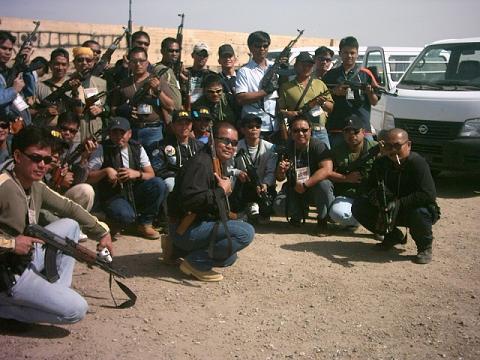
(Above photo shows Filipino armed personnel in An Numaniyah, Iraq www.ellentordesillas.com/.../2006/07/iraqjp.JPG)

Bukud sa GUN for HIRE, PRIVATE ARMIES (political clans), "secret marshall" at iba pang criminal syndicates na maaring may koneksyon, may sabwatan at gamitin ng ilang matataas na Generals sa AFP kontra kaaway sa pulitika, ang CAFGU-militia ang magbibigay dagok sa lumalalang HUMAN RIGHTS VIOLATION ng gubyernong Arroyo. Hindi rin tayo magtataka kung bakit nagpapatuloy ang kaduda-dudang pagpapasabog at pambobomba na kadalasa'y ibinibintang palagi sa Abu Sayaff at Jemaah Islamiya, mga tukuy raw na mga terorista ng bansa.

Papakumplika na ang sitwasyon ng mundo, hindi lang NAPOCOR, TRANSCO, MWSS, PAL at PETRON, pati counter insurgency ay pina-privitized na.

- Doy Cinco / IPD
Oct 8, 2007
----------------------------------------

By Ghali Hassan

07 October, 2007
Countercurrents.org

On Sunday 16 September 2007, at least 28 innocent Iraqi civilians, including women and children, were murdered by Blackwater mercenary army. The cold-blooded massacre was an unprovoked violence designed to terrorise and strike fear among the Iraqi population living under murderous Occupation. (photo:Mercenaries: Privatizing War / dusteye.wordpress.com)

According to Iraqi police, survivors of the massacre and numerous witnesses, the Sunday attack at al-Nisoor Square was unprovoked and deliberate. It is just one of countless cold-blooded massacres of Iraqi civilians by U.S. forces and foreign mercenaries (“private security contractors”). These massacres were not isolated “incidents”, a euphemism used by the U.S. Government and Western media to describe the murder of innocent Iraqi civilians by U.S. forces and foreign mercenaries. These crimes are virtually an every day unprovoked occurrence, and have inflicted “significant casualties and property damage” on the Iraqi civilian population.

There are more foreign mercenaries than foreign soldiers. Their number range from 160,000 to 180,000, working in more than 180 mercenary firms. Some of the mercenary firms (e.g. Titan and CACI International) involved in torture, abuses and even murder of Iraqi prisoners and Iraqi detainees at U.S.-run prisons, including Abu Ghraib.
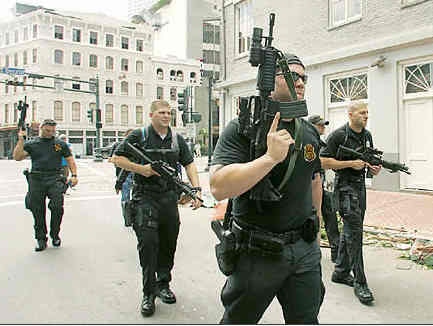
Of the mercenary firms, Blackwater is the largest of the U.S. State Department mercenary firms – the others are DynCorp and Triple Canopy -, with an additional contract worth $15 billion from the Pentagon. Blackwater is deeply embedded in the Bush Administration through its strong ties to the Republican Party and the Evangelical Christians. Blackwater mercenaries are America’s Brownshirts, and according to author Naomi Wolf; “most [Americans] don't know that Blackwater has a mandate to start operating in the U.S., and in fact they have already done” so in hurricane-ravaged New Orleans. (photo: www.commondreams.org)

In addition to foreign mercenaries, the U.S. Administration has created, armed and finance local militias to foment civil strife and divert public attention and the Resistance away from the Occupation. The U.S. administration encourages and uses the violence to destabilise not only Iraq, but also the entire region and justify U.S. military presence and the ongoing Occupation of Iraq.

According to a memorandum prepared by U.S. congressional House Committee on Oversight and Government Reform, Blackwater’s mercenaries have been involved in 195 acts of violence from 01 January 2005 through 12 September 2007 (citing Blackwater’s “incidents reports”). This is an average of 1.4 shooting per week. However, a former Blackwater mercenary who spent three years in Iraq, told NBC News, his 20-man team averaged “four or five” deliberate shootings a week, or several times the rate of 1.4 shootings a week reported by the company. The Memorandum noted that, in most cases (84 per cent), Blackwater mercenaries were found to have acted unprovoked and deliberately murdered Iraqi civilians.

Almost all Blackwater crimes against Iraqi civilians went unnoticed and most of the crimes were covered-up and forgotten. According to the House Committee memorandum: “The State Department's primary response was to ask Blackwater to make monetary payments [and] to put the ‘matter behind us’ rather than to insist upon accountability or to investigate Blackwater personnel for potential criminal liability”. Blackwater is also involved in writing-up the Sate Department’s initial report “investigating” the September 16th cold-blooded massacre of Iraqi civilians in Baghdad. The aim seemed to cover-up and conceals the murder of innocent Iraqi civilians by foreign mercenaries protecting Occupation officials.

The U.S. (Bush) Government pays Blackwater $1,222 per day for one Blackwater “Security Specialist”, which “amounts to $445,891 per contractor” per year. In addition, mercenaries use the latest and most lethal weapons. According to Jeremy Scahill, author of Blackwater: the Rise of the World’s Most Powerful Mercenary Army, foreign mercenaries in Iraq are even using “experimental ammunition” that U.S. forces are not allowed to us. The bullets which made of “blended metal” are designed to shatter on impact, creating “untreatable wounds” and completely destroying that section of the victim’s body. Foreign mercenaries are not subjected to any Iraqi laws, and immune from prosecution.

Immunity from prosecution for crimes committed in Iraq, including killing Iraqi civilians, is not coincident. The so-called Order 17, issued by U.S. Proconsul, Paul Bremer in June 2004 – as a reminder of Iraq’s fake sovereignty under murderous Occupation –, grants sweeping immunity to foreign mercenaries and outlaws working for the Occupation in Iraq. Order 17 is simply a licence to kill. With a U.S.-installed puppet government in Baghdad, the murderers of Iraqis civilians will remain unpunished and protected, unless Order 17 and the likes are abolished. The puppet government has acknowledged that “Iraqis do not understand how a foreigner could kill an Iraqi and return a free man to his own country”. What a shameful country?

In April 2004, Blackwater mercenaries were involved in indiscriminate shooting of peaceful Iraqi protesters in Najef. The crimes weren’t even reported. A video (America’s Private Army) on YouTube shows a Blackwater thug describing Iraqi civilians they are murdering as “fuckin' niggers”. In a 2005 video posted on GlobalResearch, British mercenaries were shown shooting at Iraqi civilians “for entertainment”. So far, no one has been brought to justice for killing Iraqi civilians, and all those who committed crimes against Iraqi civilians have been smuggled out of Iraq.

Furthermore, in March 2003, Iraqis killed four Blackwater mercenaries in Fallujah in retaliation for the killing of 18 Iraqi civilians, the U.S. army took revenge. In April 2004, the City of 300,000 people was besieged by U.S. marines and their collaborators. As a result of subsequent U.S. attacks lasted several months and a violent invasion in November, Fallujah was deliberately destroyed. More than 6,000 innocent civilians were murdered in cold blood by U.S. marines and collaborators. Today, the City, like many Iraqi cities and towns, remains a ghost town and most of its population are displaced refugees.

Iraqi civilians have become preys for “trigger happy” foreign mercenaries and U.S. troops. The murder of innocent Iraqi civilians has been normalised, and murder charges against U.S. soldiers and mercenaries accused of killing Iraqi civilians have been dropped in order to encourage recruitment of soldiers and foreign mercenaries. More than a million innocent Iraqi civilians, mostly women and children have been killed as a result of this illegitimate murderous Occupation and the 2003 illegal act of aggression perpetuated by war criminals aiming at dominating the world by force. Lets’ not forget that the war on Iraq is a war crime against humanity.

As I write these lines, U.S. occupying troops backed by aircraft attacked a town north of Baghdad at dawn on Friday (05 October 2007), killing at least 25 innocent civilians and injuring more than 28. On Thursday, the U.S. military admitted that it had killed five women and four children in a raid by fighter jets on a house in the small Iraqi village of Babahani. The Pentagon had initially reported the killing of “seven suspected insurgents” in the airstrike on the civilian neighbourhood. Two days earlier, U.S. helicopter gunships attacked a neighbourhood in Baghdad and killed at least seven civilians. The U.S. army in Iraq is in itself a foreign mercenary army differing only from other foreign mercenary armies in that it provides the soldiers with uniforms and use them to protect state power.

Finally, Blackwater’s mercenaries and other foreign mercenaries are part of U.S. military Occupation and therefore are accountable by the Uniform Code of Military Justice. If not; they should be prosecuted in U.S. courts. If Iraq is a “sovereign” state, then any one committed crimes in Iraq should be subject to prosecution in Iraqi courts.

Under the U.S. Federal Criminal Code, which also defines terrorism, the massacres of innocent Iraqi civilians by foreign (Blackwater) mercenaries in Iraq were deliberate acts of terrorism not different from other acts of terrorism.


Ghali Hassan is an independent writer living in Australia.

Friday, October 05, 2007

Pilipinas, Burma look alike (re brutal dispersal of Protest Action)

Hindi pa humuhupa ang panunupil sa Myanmar / Burma. Hindi pa lumalamig ang indignation ng mundo, patuloy na umiinit ang labanan, ang laman ng mga pahayagan ng mundo sa matinding pang-aapi ng gubyernong militar ng Burma laban sa mapayapang pag-aalsang mamamayang Burmese. Laman ng print at broadcast media, lokal man at international tulad ng BBC, Aljazeera, German DW at CNN ang karahasan at kalupitan ng diktadura sa Burma.
(photo:
Sinabayan ng rally ng mga guro ang pagdiriwang ng World Teachers Day kahapon kung saan nagmartsa sila papunta sanang Malacañang ngunit pinigilan agad ng mga anti-riot police. Iginigiit ng mga guro na ibigay ang mga kaukulang benepisyo para sa kanila. (Carlito Arenas) http://www.abante-tonite.com/issue/oct0607/main.htm)

Copy cat, plakado't kahalintulad sa Pilipinas ang postura't istilo ng gubyernong military Junta ng Burma. Paulit-ulit kong napanuod sa cable-TV at Internet ang walang habas na crackdown, pagbubuwag ng mga rally at demonstrasyon, ang walang awang pamamalo ng truncheon, pamamaril, paninir-gas (teargas) at panghuhuli ng mga nagpoprotesta. Bukud sa may 2,000 libo na ang inaresto at ipinakulong, may 10 ang pinaslang at 'di mabilang na nawawalang mga aktibista ang pinaniniwalaang dinukot ng mga militar, hindi pa nito nalalampasan ang ilang libong biktima ng political killings, pagto-torture at pandurukut sa mga aktibista.

photo: violent dispersal sa Pilipinas, http://www.indymedia.org/icon/2004/06/111359.jpg )

Isang shocking na balita kahapon sa ABS-CBN (Oct 5, 2007) na may ilang grupo ng mga GURO, ang TEACHER'S – INC ang nag-assemble malapit sa Mendiola upang igunita ang pandaigdigang araw ng mga GURO (World Teacher's Day) at ihayag ang abang kalagayan ng sektor ng mga guro sa Pilipinas, meaning buong mundo ang nagdiriwang, hindi lang ang Pilipinas. Tulad ng inaasahan at tulad sa kinahinatnan ng mga MONK sa kamay ng mga militar sa BURMA, ginulo, binulabog, nagkaroon ng crackdown at pinagpapasista ng mga police, ng mga Palo Ng Palong (PNP) mga pulis Manila ang matahimik na rally ng mga GURO , sa ilalim ng isang maka-ERAP, oposisyon at may moralidad daw na si Mayor Alfredo Lim. (photo:http://asapblogs.typepad.com/photos/uncategorized/2007/06/07/shoo_32900708_916.jpg)

Ang nakakalungkot, ito'y mga GURO, hindi mga militanteng mga kabataang estudyante, hindi magsasaka't manggagawa, hindi mga Urban Poor at higit sa lahat, hindi mga COUP plotters, hindi komunista, Abu Sayaff at terorista, sila'y mga Pilipinong Guro, mga iginagalang at kapatid nating mamamayang Pilipino, ang gumagabay sa edukasyon ng ating mga anak.

Ang nakaka-intriga, wala pang isang Linggo ang pagmamayabang at propaganda line ni Ate Glo sa United Nation - General Assembly hinggil sa kaso ng karahasan sa Burma. Ang ipokritong katagang “this is the time for Burma to return to the path of democracy,” she said. By “path of democracy” she apparently meant the Philippines, which she called “the most democratic country in our region,” and specifically her rule, which she pronounced as having “no tolerance for human rights violations at home and abroad.” May naniwala pa kayang head of state sa mundo na may demokrasya sa Pilipinas?

Walang respeto sa karapatang pantao ang gubyernong Arroyo. Ipinakita ito sa halos anim na taong nasa political survival mode si Ate Glo. Sa pamamagitan ng CPR, BP880, 464, emergency rule at iba pang mga kahalintulad na kautusang anti-Pilipino, inilibing ni Ate Glo ang people's democratic exercise of dissent and protest ng mamamayang Pilipino. Habang hayagang pinupuna ni Ate Glo ang kalupitan ng military Junta ng Burma, hindi ito nanalamin at nakita ang kanyang sarili. Tulad sa Burma, walang awang hinahambalos at niyuyurakan nito ang mapayapang pag-aasembliya at pagpoprotesta ng sariling mamamayan.

Kahit ibinasura na ng Supreme Court, walang dudang nananalaytay pa magpahanggang ngayon ang Calibrated Preemptive Response (CPR) policy. Patuloy na pinagwawagwagan ng PNP ang “no permit No rallies,” ang pagbabawal ng mga demonstrasyon at rallies kahit ang mga ito'y mga non-violence na pamamaraan. Kung patuloy na yuyurakan at walang intensyon si Ate Glo, ng mga LGUs at PNP na tupdin ang mandato ng CHR (Commission of Human Rights) at Human Rights DEclaration ng United Nation, na protektahan, irespeto at i-uphold ang Karapatang Pantao sa bansa, lalabas na mas masahol pa tayo sa Burma. Hindi lang ito labag sa alituntunin ng UN declaration of Human Rights, labag na labag din ito sa ating sariling Constitution, partikular ang Article III, Section 4 of the Bill of Rights.

Sagradong karapatan ng bawat mamamayan na malayang magsagawa ng matahimik na mass action, magprotesta, i-assert ang karapatan sa kalayaan sa pamamahayag, mga grievances at peaceful assembly kahit saang lugar o sulok ng bansa, ito ma'y sa Mendiola, EDSA, Camp Crame at iba pa, ika nga ni Senator Joker Arroyo, “with or without permit.”

Hindi maaring tumbasan ng mga nakakatawang mga palusot ng PNP, tulad ng “maximum tolerance,” Traffic Jam, massive inconvenience karapatan daw ng ilan, destabilization at No permit No rally" ang sagrado at universal na karapatan ng mamamayang Pilipino na magpahayag ng mapayapang pagkilos, ang inaasam-asam na demokrasya't kalayaan. Hindi na mabubura ang ala-ala ng Edsa 1, Edsa II at Edsa 3.

Ang nakaka-alarma, kung walang masulingan ang mamamayan upang mai-adres ang mga kahilingan, kung walang mga demokratikong institusyong aagapay at sasalo sa mga hinaing, patuloy na sasagkaan ang mga mapayapang pagkilos ng mamamayan, ingredient, fertilizer ito't itinutulak lamang na mag-underground at magrebelyon ang mamamayan, lalo lamang lalakas ang grupong mga extremista ng country.

Hindi tayo nagtataka kung bakit hindi lumalakas ang panawagang LEGAL na pamamamaraan, ang panawagang REPORAMA ng ilang grupo at sa kabilang banda, hindi humuhupa, nagki-click, hindi mabura-bura ang RADIKALISASYON, ang panawagang pagrerebolusyon at marahas na pagpapabagsak ng mahina at lulugu-lugong estado at gubyernong mapanupil ng kasalukuyan naka-upo sa Malakanyang. Tama ang kasabihan ng marami na, ang “VIOLENCE ay tinutumbasan at tinatapatan lamang ng isa pang Violence.”

Doy Cinco / IPD
October 5, 2007

Wednesday, October 03, 2007

Ala-ala ng BURMA

Doy,
Magandang i-post mo sa blog mo ito. Hingi ka lang ng permission kay Jade. jade_worldwide@web.de
Enteng
===========
From: jade_worldwide
To: tbak_group@yahoogroups.com
Wednesday, September 26, 2007 6:32 PM

Hindi man direktang may koneksyon sa mga nangyayari ngayon sa Burma, gusto ko lang i-share iyong panahon na isang taon ang namalagi doon.
Ala-ala ng Burma

Maigting kong sinusubaybayan ang mga pangyayari ngayon sa Burma. Malapit ang bansang ito sa akin kasi 7 taon na ang nakalipas ng nanatili ako ng isang taon sa Norte malapit sa border ng Tsina.

Ayaw ko pa sanang ma-assign doon kasi hindi siya demokratiko hanggang naisip ko, lahat ng bansang may proyekto kami ay hindi demokratiko. Type ko sana ang North Korea noon, (shades of MASH, baga), kaya lang nagsara ang proyekto dahil sa kakulangan ng access sa mga nagugutom na Koreano.

So ayun, napadpad ako sa isang town sa Norte, Myitkina, isang araw na lakbay mula sa Mandalay sa tren. Pero siempre, eroplano ang sinakyan namin. Dito kapag militar ka libre ang pamasahe mo, kapag hindi, bayad ka. Kapag banyaga, dolyar ang bayad mo. May kasamang dasal kapag sumakay ka sa eroplanong ito, dahil hindi maganda ang rekord nito sa pananatili sa ere. Iyong isang NGO nga kailangan magbiyahe sa Mandalay para sumakay ng mas safe na eroplano. Eh, kami, astig ba kami o wala lang paki iyong pinaka- boss namin? Ewan. Katabi ko pa naman sa eroplano noon ay isang unipormadong sundalo, na nag-bibilang ng dasal o mantra sa kanyang buddhist beads. Gusto ko sanang tanungin, ilan na ba ang napatay mo..kaya lang baka patalsikin ako sa bansa wala pang 24 oras. (photo: Chaotic Yangon, Myanmar, 2005 ,
i.pbase.com/.../medium/40198913.Yangonchaos.jpg)

Walang regular na kuryente, bawal ang satellite phone, at ang e-mail namin noon, pini-print-out sa Yangon at ipinapadala sa eroplano. Ang sagot naming sa e-mail, diskette naman pabalik sa Yangon. Lahat ng kilos mo ay alam ng mga may interes. Lahat ng sabihin mo sa e-mail o telepono ay sigurado kang may ibang mata o tenga na may interes kaya siempre self-censorship. Wala kang mabasa sa diaryo kundi ang mga aktibidades ng mga opisyales (minsan tinitingnan mo na lang ng maigi ano ba ang hidden meanings, trends na nangyayari sa bansa), sa telebisyon ganoon din, walang katapusang footages ng mga opisyales. Para akong bumalik sa Martial Law period, mas masahol nga lang. (photo: Yangon/www.travelpod.com)

Ang tanging libangan ng mga tao doon ay karaoke o kaya tumambay sa tea shop at doon maghuntahan ng mga walang kawawawaang mga topic dahil takot na takot silang batikusin ang gobyerno. Sarado ang mga kolehiyo noon kaya bagnot na bagnot ang mga kabataan doon. (kaya din magagaling ang mga health educator naming dahil nga mga estudyanteng bakante ang binigyan namin ng trabaho). Mababait at parang mga pinoy din ang mga naka-trabaho namin. Ang mga opisyales naman tali ang kamay nila ng mga direktiba mula sa commander. Nanghihinayang ako sa potensiyal ng mga tao at maraming likas na kayamanan ang bansa, napupunta lang sa bulsa ng iilan. (photo:www.gaia-s.net/.../Yangon/images/cityLife.jpg)

Bawat field visit namin ay alam kaagad kung ilan kami, saan kami pupunta at saan kami tutuloy. Lintsak, pati siguro oras ng paggising namin alam nila. Ang worry ko lang talaga ay kung madisgrasya kami (wala nga palang proper na kalsada doon), bawal ang radio , bawal ang satellite phone….anak ng tutsang, paano na lang. Ang siste ay magpaabiso sa militar at hintayin ang susunod na mangyayari.
(photo: From Yangon to Mandalay by TRAIN one way will ... www.tropictravel.org/pb/wp_77064307/images/im...)
Natawa nga ako minsan kasi 3 teams kami kaso isa lang iyong nakatokang sundan kami. Iba-iba ang direksyon ng lakad namin, hindi malaman ng mama kung sino ang susundan niya. Kaya pagdating ng gabi, pumunta iyong mama sa tinutuluyan namin at nakiusap na sabihin na lang sa kanya kung saan-saan kami nagpunta kasi malalagot daw siya sa mas nakakataas sa kanya.

Bakit nga ba ako nandoon noon? Talamak ang problemang HIV doon kasi ito ang lugar ng pinakamalaking mina ng jade sa bansa kaya naman daang-daang libong mga kalalakihan ang nagbabakasakali ng swerte nila dito. Para bang California Gold rush, hindi nga lang ganoon ka-romantiko. Nandiyan na lahat aliwan sa isang lugar na nakabatay sa swerte: prostitusyon, sugal, alak, droga. Matindi ang pinakahuli kasi hindi basta-bastang droga , heroina ang tinitira ng mga gustong kumawala sa realidad. Mas mura pa sa beer ang presyo ng isang shoot ng heroina.

Kung titingnan mo nga naman ang isang jade na hindi pa na-proseso, mukha lang siyang ordinaryong bato. Pero malalaman mo lang na jade kapag sinipat-sipat ng flashlight ang kung ano mang linyang dumadagtay sa bato. Siempre pa sino ang nakikinabang sa minang ito kundi ang mga nakasuot ng berde at may armas na ipinapadala ang jade at teak na kahoy sa Tsina.

Ubod ng baba ang pasweldo sa gobyerno kaya lahat na lang may raket. Pati mga doktor at nurse at para-medical staff ay rumaraket para lang mabuhay. Ang epekto nito, nagiging negosyo ang panggagamot at kahit hindi mo kailangan , makukubinsi kang bigyan ng suwero, mas makulay ang nasa suwero , mas mabuti (rosa, dilaw atbp). Kada 6 na buwan ililipat ng lugar ang mga doktor, titser, nars o para-medical staff pwera na lang kung may panlagay ka sa mga opisyales. Ang siste yatang ito, ay para hindi ka makabuo ng simpatiya sa populasyon.

Kaya naman sa hindi inaasahang pagtaas ng gasolina ngayon, talaga naming ipit na ipit na ang mga mamamayan ng Burma. Ilang libo ba ang illegal na nagta-trabaho sa Thailand? Iyong driver namin, sa panahong iyon, 8 taon na niyang hindi nakikita ang asawa niya na nagta-trabaho sa Thailand.

Sana nga makawala na sila sa pagkakasakal mula sa military.
-----------------/////--------------------

Monday, October 01, 2007

Forgetting Gandhi On International Non-Violence Day

Ang dominant ideology sa kasalukuyan ay halos punong-puno ng kapraningan, kalituhan, hinagpis, kawalang pag-asa, kaguluhan at yumayakap ang sangkatauhan sa masalimuot na takbo ng buhay at lipunan; ang CULTURE of VIOLENCE, violent societies, violent political system, violent state / governments, violent film/movies at telenovelas, violent media, violence against women, violent internet games, violent corporate industries, violent families, violent fraternities, violent social movements, violent families at iba pang violence na magkakaugnay sa araw-araw na takbo ng buhay.

Hindi natin alam kung matatanggap ng LAHAT (dulong kanan at dulong kaliwa) ang ganitong panawagan ng mundo (United Nation). Malamang isiping "suntuk sa buwan" o imposibleng mangyari sa kasalukuyang kalakaran, sapagkat ang kontradiksyon ng tao sa tao, ayon sa sa mga doktrinang pinaniniwalaan ay "sadyang hindi pantay at mapagsamantala, ay likas na may may mahirap at may mayaman, ang sangkatauhan tulad ng hayop/mababangis na hayop ay likas na mabagsik, violente at survival the fittest." Maaring mali, tama o maaring matagalan ng ilang henerasyon upang maisakatuparan ng pautay-utay ang kaganapan ng ganitong adhikain.

Doy Cinco / IPD
Octover 2, 2007

Forgetting Gandhi On International Non-Violence Day
By Pablo Ouziel
01 October, 2007 Countercurrents.org

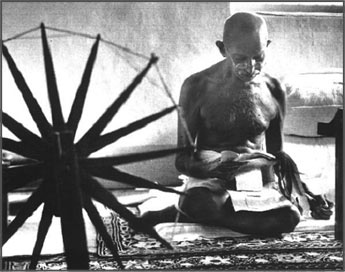
(photo: http://www.iloveindia.com/indian-heroes/gifs/mahatma-gandhi-ji-india.jpgroes/gifs/mahatma-gandhi-ji-india.jpg)

October 2nd will mark the birth anniversary of Human Ri
ghts Activist, Mahatma Gandhi and for the first time, the United Nations is officially proclaiming this day to be the International Day of Non-violence. Hopefully, on this day we can all spare a little of our time to reflect on how little we have all understood Mahatma Gandhi's message, after all everyday we seem to plunge into a worse state of affairs and drift away farther from Gandhi's respectable message; "I object to violence because when it appears to do good, the good is only temporary; the evil it does is permanent."
(photo:
Blackwater Mercenaries / unitedcats.wordpress.com)

I wonder what it means to have an International Non-violence day. Does it mean that American soldiers, UN 'peacekeepers', Nato Forces, the Israeli military and Blackwater USA will put down their weapons for the day and reflect on the horrors that they are committing in the vague name of an international war on 'terror'? Does it mean that they will all continue killing as a few peaceful marchers around the world proclaim in total sanity, that the insanity that prevails is making it hard for peace-loving humans to coexist with this madness? Or those it mean, that the United Nations will clamp down on the killings perpetrated by the permanent members of its own security council?

Whatever happens on that day we can all rest assured that the day will pass and things will continue heading into the same almost unavoidable tragic ending, one which
the respectable Professor Noam Chomsky describes in the following way; "The immediate fear is that by accident or design, Washington's war planners or their Israeli surrogate might decide to escalate their Cold War II into a hot one – in this case a real hot war."

Gandhi once said that, "an error does not
become truth by reason of multiplied propagation, nor does truth become error because nobody sees it." However since that now famous speech in 2001 when President Bush declared; "You're either with us or against us in the fight against terror," our lives have changed so much in so little time, that one wonders whether Gandhi's statement makes any difference to the lives of ordinary innocent people.

With so many dead since Bush's statement
and so many more suffering, with our way of live being put upside down by secretive prisons, humiliating airport security checks, increased racism towards our Muslim brothers, students being tasered for asking inappropriate questions, and the president of a country being insulted by a University President in the name of freedom of speech, one wonders how long we will have to put up with this reality until the people of the world regain their rights and react against this vile oppression.

We are living in fearful times void of any reason, if one listens to the words of world leaders and reflects on their actions, one will see the incoherence which prevails. The ones promoting global democracy are embracing imperialism and the ones asking for reason to flourish are being labelled as enemies. Evo Morales the first indigenous president of Bolivia, who was linked to Osama Bin Laden by the American ambassador in that country, last week speaking with Amy Goodman of democracy Now! said; "I think that in this new millennium, we fundamentally should be oriented towards saving lives and not ending lives." (photo: Hugo Chávez and Evo Morales / opotesta.files.wordpress.com/2007/04/democrac...)
Yet President Bush continues to raise the flag of peace and stability as American defence company stocks continue to rise and people continue to die. According to CNNMoney.com on September 26th; "The AMEX Defense Index, which tracks 14 major defence company stocks, rose 14.25 to a high of 1,686.72 in afternoon trading. Since last year, the index has risen roughly 47 percent, outperforming the broader S&P 500 index, which has climbed nearly 15 percent over the same period."
(photo: The Living Weapon http://www.blogger.com/www.pbs.org/.../weapon/filmmore/ps_large.htmlfilmmore/ps_large.html) / www.pbs.org/.../images/filmmore_ps_large_1.jpg)

Whi
le Hugo Chavez president of Venezuela, another 'great enemy' of the American people during a UN address at the General Assembly in 2006, recommends to the assembly, the presidents of the world and in particular the American people to read Hegemony of Survival by Noam Chomsky, we learned this week by the hand of an editorial in The Los Angeles Times that, "the biggest beneficiary (of the business of war) has been Blackwater USA, a private security firm with powerful political and personnel ties to an administration that has awarded it more than $1 billion in contracts since 2002."

So while this real life scenario remains a despicable reality and some blame Bush, while others blame corporations, I am inclined to blame the common people who through a combination of indifference, fear and lack of reason, are allowing their government representatives and a few corporations to accumulate wealth and power, while destroying the planet in which we all live. We must understand that the power is in the hands of the majority as long as we are all willing to accept that responsibility and turn it into action. (photo: International Day of Peace / www.internationaldayofpeace.org/images/UN-IDP...)

If we use International non-violence day to reflect on Gandhi's teachings and his struggle for freedom, we might learn from his own words that, "as human beings, our greatness lies not so much in being able to remake the world - that is the myth of the atomic age - as in being able to remake ourselves." If this reasoning can somehow ingrain itself into our thought process, those Wall Street and industry executives who are trying to assure investors that there will be little disturbance in military spending over the next several years, regardless of who succeeds President Bush in the White House, will be proved wrong. If however the people of the world have forgotten what Gandhi really stood for, there is nothing that can be done.


-Pablo Ouziel is an activist and a free lance writer based in Spain. His work has appeared in many progressive media including Znet, Palestine Chronicle, Thomas Paine’s Corner and Atlantic Free Press.