Friday, September 28, 2007

Return of Balangiga Bell, malabo pa rin

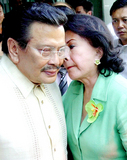
Sa araw na ito, habang nakikipag-landian si Ate Glo sa mga maimpluwensyang Amerikano sa New York, USA, kasa-kasama ang kanyang kaklase sa Georgetown University na si President Clinton sa isang pagtitipong Clinton Global Initiatives, walang kaalam-alam ito na dito sa Pilipinas ginugunita ang 106th anniversary ng Balangiga Encounter, isang ala-alang mapait, mapang-api at madugong karanasan ng Pilipinas sa kamay ng Estados Unidos, lalong-lalo na ang mga ninakaw na mga Kampana sa simbahan ng Balangiga. (photo: Pres Arroyo watches former US President Bill Clinton speak during the third annual Clinton Global Initiative at the Sheraton Hotel in New York city. - Photo By AP / http://www.philstar.com/)
Sa araw na ito naganap ang isang makasaysayan at kauna-unahang matagumpay na enkwentro ng pakikidigmang
guerilla ng mga Pilipino laban sa mananakop at sopistikadong armas pandigma ng mga mananakop na Amerikano. Ang nasabing inkwentro ay sa pagitan ng 9th US Infantry Regimen at ang revolutionary command officer na si Brig. General Vicente Lucban, itinalagang political at military Governor ni President Aguinaldo sa probinsya ng Samar.

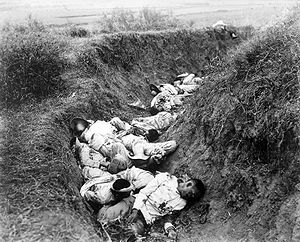
May 48 na sundalong Amerikano ang napatay, 22
ang sugatan at ilang daang rebolusyunaryong mandirigmang Pilipino ang nagbuwis ng buhay sa labanan. Naganap ang makasaysayang inkwentro noong Setyembre 28, 1901 sa bayan ng Balangiga, Samar. (photo: http://www.bakbakan.com/images/slukban.gif)

Kaya lang, nakakalungkot isipin na ni-isa mang mataas na opisyal ng gubyerno ay tila nakalimot na sa nakaraan, wala mang nakaalala (government agencies), nagkaroon man lang ng isang parandam na aktibidad, naibroadcast man lang, kahit paano'y nai-lobby man lang at nai-follow-up man lang ni Ate Glo sa kaeskwelang si Presidentent Clinton o sa US Congress man lang sa kung paano makakatulong ito para maisayli ang tatlong Kampana ng Balangiga.

Sa katanungang marerecover pa ba ng Pilipi
nas ang tatlong mga ninakaw na KAMPANA sa Balangiga? Sa klase at katangiang BURIKAK ng mga umuukupa sa Malakanyang, umasa ka pa, malabo!

Sa totoo lang, kung usapin ng inspirasyon ng mga Pilipino sa kasaysayan, ito na ang tamang panahon, ang dapat ginugunita at pinaprioridad ng gubyerno, ang pagpapalaganap ng kagitingan at kabayanihan ng mga Pilipino at hindi ang karaniwang mga talunang labanan kontra dayuhan (Fall of Bataan, Fall of Tirad Pass at iba pa). Ang insidente ng Balangiga ay tanda lamang na
likas na rebolusyunaryo ang ating mga ninuno, isa rin itong ambag sa estratehiya at taktika ng pakikidigma para sa kalayaan at soberanya ng mga Pilipino sa mundo, partikular na katangiang rebolusyunaryo ng mga Waray-Waray. "Dahil sa kaganapan ng Balangiga (pagsasauli ng 3 Kampana), ipinapalagay ng ilang mga makabayang Pilipino na ang digmaang sa pagitan ng Estados Unidos at Pilipinas ay sa totoo lang ay hindi pa ganap na natatapos." (photo: General Jake "Howling" Smith and his staff inspecting the ruins of Balangiga in October 1901, a few weeks after the retaliation by Captain Bookmiller and his troops.http://www.bibingka.com/phg/balangiga/default.htm)

Dahil sa tindi ng pagkatalo’t kahihiyan, ipinag-utus ni Gen. Jacob Smith na linisin ang probinsya ng Samar (sunugin ang Samar) sa mga "insurektos, terorista at sa mga bandido." Bilang ganting salakay, halos pinulbos ng mga sundalong Amerikano ang "bainte porsiento (20%) ng populasyon" ng Balangiga, karatig bayan at buong isla ng Samar. Bata, matanda at babae ang minasaker, ni-rape at sinusog, ginawang abo ang mga ari-arian ng ating mga kababayan at ang pinakamasaklap, bilang “war booty o trophy,” ninakaw ng mga tropang Amerikano ang tatlong Kampana at ilang cultural artifacts ng simbahan ng Balangiga.
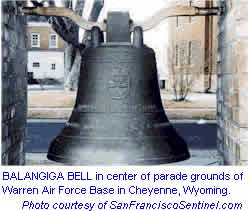
Ang tatlong Kampana na may markings na 1853, 1889 at 1896 emblems ay pag-aari ng Franciscan Order. Ninakaw din ng mga Amerikano ang English made na cannon na may emblems na 1557. (photo:http://www.philnews.com/2005/da.html)

Hindi nalalayo sa kaso’t kinahinatnan ng Iraq at Vietnam ang ginawang kalupitan, pagnanakaw ng US sa Pilipinas.
(photo: A late 19th century photograph of Filipino rebels, known as the Katipuneros. upload.wikimedia.org/wikipedia/commons/thumb/...)
Bahagi lamang ng isang malawakang pakikibaka, ng national liberation movement ng mga Pilipino laban sa mananakop at kalupitan ng Imperyalistang Estados Unidos ang insidente ng Balangiga. Ayon kay Prof. Roland Simbulan, the “U.S. government must officially apologize for atrocities in Philippine- American War.”

Kung may buto sa gulugud ang ating mga namumuno, maaring suportahan nito ang inisyatiba o pagkakaroon ng class suit (tulad ng milyong European JEWs na pinatay ng bansang Germany) laban sa bansang Amerika at pagba
yaran ito ang DAMYOS pinsala sa mga Pilipino.

May mahigit 300,000 civilian mga Pilipino ang walang awang pinagpapatay ng mga tropang Amerikano
sa kampanyang anti-insureksyon at terorismo laban sa bagong katatag na Republika ng Pilipinas. Ginamit ang mga sopistikado, hindi makatao at barbarong paraang mga torture (water cure) at interrogation, gayun din ang pamamaraang “search and destroy operation,” hamletting at brutal na reconcentration (taktikang militar na ginamit sa kampanyang paglipol sa American Indians) laban sa mga kababayang nating mga Pilipino.

Ang lahat ng mga pangyayari at kaganapan ng panloloob ng mga Amerika sa Pilipinas ay pawang nasa mga American libraries, dokumentado, at nasa mg
a History Books at ang malungkot, imbis na taguriang mga rebolusyunaryo at kabayanihan ng mga Pilipino, binansagang mga insurekstos at terorista ang mga ito. Lumalabas sa kasaysayan na ang ginamit na “Philippine Insureksyon” ng mga Amerikano ay malinaw na isang PAG-AALSA, isang makatwiran pakikibaka laban sa mga MANANAKOP na Amerikano, laban sa panloloob at pwersahang pag-ookupa ng isang makapangyarihang bansa sa isang bago at soberanyang bansa Pilipinas.

Ilan sa mga dokumento na maaring makatulong sa kung paano ilarawan ang panloloob at pananakop na tinaguriang “unang Vietnam” ng bansang tinatawag na nagpapalaganap raw ng “demokrasya sa Asia,” ang Imperyalistang Amerika. (wikang english nga lang)

Deaths and Atrocities
(photo:
upload.wikimedia.org/wikipedia/commons/thumb/...)
There are atrocities in any war. However, in the Philippine- American War, brutality reached a level unprecedented in American history. Americans fighting in the Philippines treated their enemy with none of the civility that generally characterized wars against European opponents. They viewed the Filipinos as savages. Most of the high command had spent their careers fighting “injuns” on the American frontier, and quickly adopted even harsher methods in the islands. As one Kansas veteran claimed, "the country won't be pacified until the niggers are killed off like the Indians." “Nigger” and “gugu” were common racial slurs applied to the Filipinos. As the war intensified, killing the wounded, mutilating the dead, torture, and execution spread through the islands.
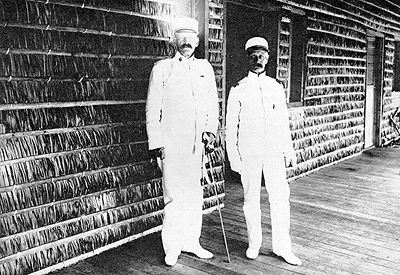
(photo:
Brigadier General Jacob Smith with Major General Adna Chaffee, Tacloban, Leyte, 1902 / http://en.wikipedia.org/wiki/Jacob_H._Smith)
I want no prisoners. I wish you to kill and burn, the more you kill and burn the better it will please me...Kill everyone over the age of ten, and make the island "a howling wilderness." --General Jacob Smith, Samar Campaign

Military Deaths

"I never saw such execution in my life, and hope never to see such sights as met me on all sides as our little corps passed over the field, dressing wounded. Legs and arms nearly demolished; total decapitation; horrible wounds in chest
s and abdomens, showing the determination of our soldiers to kill every native in sight. The Filipinos did stand their ground heroically, contesting every inch, but proved themselves unable to stand the deadly fire of our well-trained and eager boys in blue. I counted seventy-nine dead natives in one small field, and learn that on the other side of the river their bodies were stacked up for breastworks."
--F. A. Blake, of California, in charge of the Red Cross

Filipino soldiers were not the only ones to bear the brunt of American brutality. Approximately 300,000 Filipino civilians were also killed in the conflict; estimates range as high as several million. Many died from starvation and di
sease caused by the war, but in many cases American soldiers were more directly responsible. Rape, looting, and murder often followed the capture of towns.

"The soldiers made short work of the whole thing. They looted every house, and found almost everything, from a pair of wooden shoes up to a piano, and they carried everything off or destroyed it. Talk of the natives plundering the towns: I don't think they are in it with the Fiftieth Iowa." --Guy Williams of the Iowa Regiment

Filipino villages were usually the only available targets for frustrated American troops, and burning villages was commonplace, both as reprisal for attacks and to de
prive guerrillas of supplies and shelter. American ingenuity was responsible for the creation of a new weapon for this purpose--a steam fire-fighting engine converted to spray highly flammable petroleum on the villages. When Americans fell into an ambush, nearby barrios were ordered burned. If an American was found murdered in one of the towns, that town was burned.

"When you can realize four hundred or five hundred persons living within the confines of five or six blocks, and then an order calling out all of the women and children, and then setting fire to houses and shooting down any niggers attempting to escape from the flames, you have an idea of Filipino warfare." --Sergeant Will A. Rule, Co. H, Colorado Volunteers


Especially in the later stages of the war, civilians were often massacred regardless of sex or age. Suspected Filipinos were often executed without trial or evidence--Funston once bragged to reporters that he had personally hanged 35 civilians presumed to be insurrectos. In the early stages of the war commanders tried to prevent this, but as the conflict dragged on and the Filipinos were viewed with increasing hatred, such acts became increasingly common. When General Adna Chaffee took command in July of 1901, he deemed such total warfare necessary. The “kill and burn” policy on the island of Samar was responsible for countless civilian deaths. In summer of 1901, junior officers’ reprisal acts enraged the “pacified” islands of Bohol, Cebu, and
Marinduque and spurred them to new rebellion. The United States had seen war before, but it was this kind of cruelty that set the Philippines conflict apart. A nation based on the concepts of democracy and freedom soon fell into the same category with the Spanish in Cuba and the British in South Africa.
"I am not afraid, and am always ready to do my duty, but I would like some one to tell me what we are fighting for."
--Arthur H. Vickers, Sergeant in the First Nebraska Regiment
Prisoners

"Company I had taken a few prisoners, and stopped. The colonel ordered them up in to line time after time, and finally sent Captain Bishop back to start them. There oc
curred the hardest sight I ever saw. They had four prisoners, and didn't know what to do with them. They asked Captain Bishop what to do, and he said: 'You know the orders,' and four natives fell dead." --Charles Bremer, of Minneapolis, Kansas, describing the fight at Caloocan

When the war began and both sides were still fighting a conventional war, treatment of prisoners was fairly humane. However, as the war wore on and changed in character, Americans adopted crueler methods. Filipino prisoners became rarer and rarer. Filipinos who tried to surrender were often gunned down, just as if they had continued to fight.

"I don't know how many men, women, and children the Tennessee boys did kill. They would not take any prisoners. One company of the Tennessee boys was sent to headquart
ers with thirty prisoners, and got there with about a hundred chickens and no prisoners."
--Leonard F. Adams, of Ozark, in the Washington Regiment

Those captured were often no more fortunate. Prisoner of war status was often withheld from Filipinos because of General Order 100. This order was created during the Civil War and allowed for the execution of enemies employing guerrilla tactics, such as dressing as civilians and returning home between battles. Those who were taken lived in constant danger of execution; either on a whim, or as retaliation for an attack on Americans. One example was the execution of 24 Filipino P.O.W.’s by Colonel Funston, after American Lieutenant Kohler was led into a Filipino trap and hacked to death by bolomen.

In contrast, Filipinos kept American prisoners in relative comfort. They were fed well and often offered commissions into the Filipino army; three accepted. In 1899, Aguina
ldo invited four independent journalists to inspect the prisoner’s accommodations. They found that the captives were “treated more like guests that prisoners." Aguinaldo released some prisoners in order to spread the word of their kind treatment under the Filipinos. After Aguinaldo was captured, the Filipinos rarely took prisoners; mostly because they never had the opportunity. However, Filipino treatment of prisoners became much harsher in the later stages of the war, especially in Batangas. Filipino General Malvar had to issue a proclamation providing for swift punishment of any Batangueño soldiers violating laws of warfare, in response to Filipinos shooting surrendering Americans and mistreating prisoners.
"We bombarded a place called Malabo
n, and then we went in and killed every native we met, men, women, and children. It was a dreadful sight the killing of those poor creatures. The natives captured some of the Americans and literally hacked them to pieces, so we got orders to spare no one."
--Anthony Michea, of the Third Artillery

Torture: Water Cure
"When I give a man to Sergeant Edwards, I want information. I do not know how he gets it; but he gets it anyway"
--Lieutenant Arnold of the Fourth Cavalry

(Photo: Water torture in use in the Philipine-American War and Vietnam War / www.geocities.com/.../NewPhotos/WaterTorture.jpg)

The water cure was the favored method for extracting information from Filipino prisoners. The Filipino was held down and a funnel used to force water into their mouth. The prisoner was made to swallow water until their stomach was distended and near bursting. Then the Americans would pump the water back out. If the prisoner still wouldn’t talk, the process was repeated, sometimes as many as a dozen times. In a crueler version of the water cure, Americans simply poured water continuously over the prisoner's head. The prisoner couldn’t breath without inhaling water, and they would slowly drown as their lungs filled up. The water torture rarely failed; even the most patriotic Filipino couldn’t hold out for long. While most American commanders denied that the "so called water cure" was ever used, reports of it from Filipino prisoners and mentions in soldiers' letters and journals make it seem certain.

Source: http://www.geocities.com/Athens/Crete/9782/atrocities.htm

Doy Cinco / IPD
September 28, 2007

Thursday, September 27, 2007

Senator “Brenda” Santiago, sinumpong muli

Ayaw na natin patulan ang ganitong klaseng level na diskurso, kaya lang iniisip ding baka may kakaunting katwiran ang senadora, "ang pinakamatalino raw, ang may bode-bodegang diploma," ang english carabao at "positive na may sayad" sa senado. Ang puntong panlalait sa China na binawi rin kaagad (flip plof) at ang kawalang katuturan raw at pagsasayang lamang ng panahon ng Senado sa ZTE broadband scam. (photo: aboutmyrecovery.com/.../2006/12/images.jp)
Korek at kabisadong-kabisado ni Brenda ang isyu kaya't ng sabihin nitong “resulta lamang ng double cross syndrome” o normal lamang na away ito ng sistema, meaning parang agawan ng mga buwitre sa isang tipak na karne ng baboy, meaning kickback sa pagitan ng mga paksyon ng Malakanyang, ng mga tiwaling pamunuan ng gubyerno't kasama ang pamilyang Arroyo, parang bumilib na rin ako
kay Brenda.

Ang kulang sa sinabi ni Brenda ay siya mismo't mga kachokaran, mga kauri n'ya rin ang salarin
, ang elitistang klase ng pulitika, ang oligarkiya, ang factionalismo, ang sistemang padrino, casique't oligarkiya at sa kabuuan, ang kabulukan ng sistema ng pulitikang umiiral sa bansa, na siyang ugat na pinanggagalingan ng malawakang RENT SEEKING (transaksyong kurakot o laway lang ang puhunan at pangungupit sa kaban ng bayan) at katiwalian sa gubyerno.

Ito'y parang canal na pinagbubuhatan ng lamok, na habang nariyan ang pusali ay mananatili ang lamok o ang KABULUKAN NG SISTEMA ng pulitika, mananatili ang kabulukan at pangungurakot sa gubyerno. Ito ang mga kadahilanan kung bakit “walang buto sa gulugud o very WEAK ang STATE.” (photo: dusteye.files.wordpress.com/2007/01/photo-cor...)
Ang hindi sinasabi ng senadorang si Brenda ay sadyang na- institusyalisa na ang pangungulimbat sa loob ng burukrasya. Parang napaka-IMPUSIBLENG hindi ka maputikan o maulingan sa isang sitemang balon ng kababuyan at katiwalian. "Take it or leave it" ika nga. Kung ika'y "kontra agos, isang matino, malinis at straight sa trabaho, ikaw pa ang palalabasing masama, demonyo, kontrabida't walang pakisama sa nakararami." Ang katawa-tawa, "everybody happy at huwag pahuhuli ang cardinal rule." Kung 'di ka ayon sa kalakaran, ikaw ang lalabas na tanga at gago.

Ang malungkot, tulad ng maraming Brenda na pulitiko, "hinahangaan, ibinoboto, ginagawang ninong at ninang sa binyag at kasalan, iniimbitahang magsalita sa graduation rites ng mga paaralan at resource person sa mga pagtitipon at mga parangal. Ang mga pulitikong ito ay kadalasa'y aktibo sa mga civic action at kawanggawa, pinakamalaking magbigay ng donasyon sa simbahan, abuloy sa patay, at higit sa lahat, tinutularan at ginagawang modelo."

Sa huling tala ng Transparency International’s Corruption Perception Index (CPI) sa 180 bansang kasama sa survey, mula sa 121st, bumagsak ang ranking ng Pilipinas sa 131st sa kasalukuyang taon. Lahat ng mga bansang nataguriang "WEAK ESTADO, walang matatag na partido politikal, talamak ang casique't oligarkiya ay mga nasa bandang puwitan ng ranking. Hindi nalalayo ang ranking ng Pilipinas sa bansang Myanmar, Somalia, Nigeria, Afghanistan, Iraq at Sudan kung saan matatagpuan ang Darfur."
(Photo:
World map of the Corruption Perceptions Index by Transparency International, which measures "the degree to which corruption is perceived to exist among public officials and politicians". High numbers (blue) indicate relatively less corruption, whereas lower numbers (red) indicate relatively more corruption / upload.wikimedia.org/wikipedia/en/thumb/8/87/...)

Lubhang napakahalaga ang senate investigation sa ZTE broadband scam, sapagkat sa tagal na panahon talamak itong nangyayari sa gubyerno, panahon na ring kahit paano't maawat ito ng kahit kaunti ng Senado, ang nalalabing matatag na institusyon ng bansa. Kaya lang, posibleng mauwi nga sa wala at magsayang lamang ng panahon ang isinasagawang hearing ng senado kung mananahimik ang mamamayan. Ang ikinababahala, habang lumalaon, tila hanggang kay Abalos na lamang ang punu't dulo ng iskandalo. Unti-unting lumiliwanag na nagkakaroon na ng gapangan, nagtatakipan at nagsasabwatang ang marami, sa panig ng mga tauhan ng Malakanyang at ilan sa mga senador na i-damage control, proteksyunan ang pangulo at kanyang pamilya at all cost.

Ang pinaggigitgitang “in aid of legislation” ay malamang na mauwi sa walang katuturan at ang pinakamalungkot at malapit sa katotohanang “in aid of political visibility para sa 2010 presidential election ang kalabasan.” Ang tanong ng marami, may maipapakulong na kayang “big fish na malapit sa
Malakanyang” ang inbistigasyon ?

Kaya lang, sa ipinakitang asal at ikinilos ni Brenda, hindi lang astang RACIST at sobrang hangin, masyadong napaghahalatang tutang-tuta siya ng Malakanyang at kung pupwede lamang halikan ang tumbong ni Ate Glo, gagawin nito maisalba lamang ang pangulo. Tulad ng maraming sirkero, balimbing at oportunistang pulitiko, kung ating babalikan ang kasaysayan, mula kay Tita Cory hanggang kay Pres Erap Estrada, humalik sa tumbong si Brenda.

Sadyang nang-agaw na lamang eksena si Brenda ng ipagwagwagan nito ang China na isang bansang may matagal ng sibilisasyon sa silangan at nag-imbento ng kurakot. Nang matunugan nitong hopeless ng maisasalba si Abalos, imbis na si Abalos ang pag-usapan, dinavert ni Brenda sa China ang isyu't usapin. Bagamat ito'y kumambyo at nagsorry, kulang-kulang din ang laman at sustansya ang birada nito sa China.

Bagamat tamang sabihing sakim at TUSO ang bansang China, sana man lang itinaas nito ang ante laban sa mga "Intsik," muling nanawagang "iboykot ang produkto ng China, iboykot ang kumpanya ng China, sawatain ang pagbaha ng smuggled na gulay, damit, sapatos, appliances at DVD mula sa China at iboykot ang Beijing Olympic" dahil sa paglabag sa karapatang pantao, ang pagsuporta't pagtulong nito sa mga bansang awtokratiko't diktador at ang talamak na polusyon sa kalunsuran. (photo: http://www.ibgintl.com/image/delegates.gif)


Sa totoo lang, hindi lamang China ang gumagawa at nagpauso ng pangungurakot at panunuhol sa mundo, maging ang mga malalaking kumpanyang multinasyunal at TransNational Corporations/companies (TNC) sa Amerika at Europa ay ganun din at mas matindi pa kaysa China. Sapagkat hindi lamang nanunuhol at nang-uuto ang MNCs at TNCs, nananabotahe, pinapahina ang mga estado at higit sa lahat pumapatay pa ng sangkatauhan.

Para sa kaalaman ni Brenda, likas na sa isang bansang KAPITALISTA ang panunuhol at pambabraso. Lahat ng paraan ay gagawin (sakupin at okupahan ang Iraq at Afghanistan dahil sa langis) tumubo't kumita lamang ng limpak-limpak na salapi ang mga dambuhalang KUMPANYA.


Doy Cinco / IPD
September 27, 2007

Pardoning Erap, Neglecting EDSA 2

By: Gladstone A. Cuarteros
Political Reform team / IPD

September 27, 2007


In September 12, 2007 the Sandiganbayan convicted former President Joseph 'Erap' Ejercito Estrada of plunder and sentenced him to forty years impr
isonment and ordered the forfeiture in favor of the government the almost one billion pesos worth of bank deposits and assets. The verdict is the culmination of more than six years of court proceedings that started after Estrada was ousted as a result of the EDSA People Power II in January 2001. (photo: Jailed former Philippine president ... www.taipeitimes.com
Estrada was formally charged with four violations of plunder but it was in two offenses that evidence showed his guilt beyond reasonable doubt. Specifically he was convicted of plunder for taking P189.7 million in commissions from
the purchase of Belle Corp. shares by the Government Service Insurance System and the Social Security System, and P545 million in payoffs from jueteng lords. He was cleared though of diverting tobacco excise taxes for personal use and maintaining a bank account under a false name - Jose Velarde. Another case of perjury for allegedly misdeclaring his Statement of Assets and Liabilities (SAL) was dismissed.
(photo:
members.aol.com/ernestojlaput/edsa2.jpg)
Yet after the verdict was read and Estrada was flown back to his Tanay resthouse the atmosphere lacked the jubilation that usually comes with big victories. It is without the celebrations, fun fare and most of all sense of fulfillment displayed at EDSA 2. Key personalities of EDSA 2 have either became less interested with the outcome of these cases or have expressed tacit support and sympathy to Estrada. And on the part of the beneficiary of EDSA 2 – Gloria Macapagal Arroyo herself she was more concern on potential political backlash of the guilty verdict. Just two weeks into the decision of the Sandiganbayan, she is now seriously considering giving Estrada an absolute pardon. An offer that will exonerate Estrada of any accountability and will allow him to keep his supposedly forfeited bank accounts and assets.

I beg to disagree with some journalist who contend that the question of pardon
rest solely with GMA and Estrada. That it is their prerogative, whether GMA offers either a conditional or absolute pardon and whether Erap will accept the offer in return. Such position will inappropriately reduce the plunder charges as personal fight between the two presidents. And what does it imply? That in 2001 GMA and her allies then, many of whom have already deserted her, have conspired to oust Erap and grab power for themselves? If that is so, then Erap is justified in claiming that the Special Division of the Sandiganbayan that tried his cases was created only to convict him.

Secondly leaving to GMA and Estrada the question of giving pardon to the latter in effect removes completely the people from the picture. As if the multitudes who trooped to EDSA spending days and nights on the streets did not happen. How about them who have made political judg
ement on Estrada at that time?

It is just unfortunate that the morals and ethics in governance have deteriorated after EDSA 2 . Two important principles emphasized the people power. To the dismay of the large section of EDSA 2 forces, GMA did not live up to the ideals they fought for in January 2001. As a consequences her supporters from the middle class and professionals felt betrayed. That instead of lessening graft and corruption in government what transpired was a series of corruption scandals, turning the present administration to be more corrupt than the one it replaced. Among the most phenomenally notorious corruption cases are the Macapagal Boulevard, NAIA Terminal 3, Jose Pidal, North Rail Project, Hello Garci and now the ZTE-NBN contract. It comes no surprise that Comelec Chairman Benjamin Abalos and his friend First Gentleman Mike Arroyo is now at the center of the ZTE-NBN scandal. At a time when Abalos should have been busy working for a clean, honest and credible May 2007 el
ections being the head of Comelec, he even had time brokering the ZTE-NBN contract.

With seeming impunity and brazen abuses of the administration the national significance of Erap conviction have been lessened. The people are becoming insensitive to daily news of corruptionas it became too rampant for them to fathom. 'What is new' is the common reply. They rather focused themselves in their own more important struggle for daily survival. As GMA continues more people believe that she and her husband Mike Arroyo are involved in corrupt practices. Even worse compared to Estrada. Figures from two recent of SWS surveys conducted just before the promulgation by the Sandiganbayan is n evidence to this. First,
in Metro Manila and neighboring provinces, 72% of those surveyed agree to the statement that 'under the current administration corruption increased'. Those who believe GMA and Mike Arroy are involved in corruption is a whopping 77% and 71% respectively, while only 31% believe Estrada was involved in corruption. The second survey was released on the day of the promulgation where a majority of the people nationwide expected an acquittal of Estrada. This sentiment is strongest in Mindanao (63%), balance Luzon (57%) and Metro Manila (56%). Why have we come into this? It is a question that GMA and her allies should answer more than anyone else.

Indeed much have changed since Estrada left Malacanang in 2001. Politicians and groups who played key roles in EDSA 2 have already either distanced themselves from the GMA administration or have altogether joined the opposition. For example Sen. Manny Villar who have was instrumental in impeaching Estrada in 2000 is now a collaborating politically with Estrada. In fact Estrada's support allowed Villar to retain the Presidency of the Senate. Estrada's son Sen Jinggoy Estrada is also Villar's Senate President Pre-Tempore and if reports are true, will be Villar's running-mate come 2010. Other politicians are equally interested for Estrada's endorsement in the next election. Though is yet to declare his intentions but increasingly Sen. Mar Roxas is seen courting the support of the former President. His frequent visit to Estrada in Tanay, the most recent was few days after the Sandigabayan verdict, says it all.
Responses from civil society groups after the verdict are equally less encouraging. It
has been a near-amenic response, so to speak. PlunderWatch, a group in the radical left which was among the complainants in the plunder case said days ahead of the promulgation that they are no longer interested if Estrada is found guilty or not. A the more recent grouping of leftist and progressives - Laban ng Masa (LnM) smacked on the 'hypocrisy of the GMA regime' and instead argued that 'GMA and her cohorts of plunderers and murderers' be brought to justice. Although on the whole Laban ng Masa attacked the bankruptcy of the current system dominated by the economic elites and traditional politicians, they ended up sounding pro-Estrada. LnM then called for the prosecution of people involved in the Hello Garci scandal, Jose Pidal, JocJoc Bolante's fertilizer scam and the ZTE-NBN. The Black and White Movement (BnW) is formation of professionals and middle forces organized after Hello Garci scandal. Some of their members are former supporters of GMA. In their statement BnW respected and welcomed the ruling of Sandiganbayan. Though a little bit subdued it lamented on the failure of GMA in pursuing cases against Nani Perez, Jose Pidal, Jocjoc Bolante and the stonewalling of the administration through E.O 464 and Memorandum Order 108.

While civil society groups and politicians are justified in either abandoning or distancing themselves from GMA administration as it turned out to be worse than Erap's, but their near-anemic response to the guilty verdict diminishes the value of exacting accountability from Estrada. And consequently they are aiding GMA into pardoning Estrada and totally neglecting EDSA 2.
#####

Wednesday, September 26, 2007

"Economic Brief: The Economic Factors Behind the Myanmar Protests"

Dahil sa katangian ng liderato at katagalang sa pwesto (Military Junta) sa gubyerno, humantong ang hangganan, na-weakened at namis-managed ang ekonomiya ng Myanmar. Tulad ng Pilipinas, pawang military establishment na lamang ang inatupag ng gubyernong Junta at hindi ang mga batayang serbisyo para sa mamamayan, hindi malayong magcolapse ang ekonomya't gubyerno ng Myanmar.
- Doy / IPD

http://www.pinr.com/index.php
27 September 2007

The first sign of the current protests currently underway in Myanmar occurred in a rare display of public outrage over the economic conditions within the country in February 2007. A small group calling themselves the Myanmar Development Committee called on the military rulers to address consumer prices, lack of health care, education and the poor electricity infrastructure. Normally unseen in Myanmar, the protest was quickly broken up after only 30 minutes of activity. Likely in response to the protests, the ruling military junta appointed Brigadier-General Than Han of the Myanmar police to the responsibility of handling civil unrest in Rangoon.

On August 15, 2007, the government made significant cuts to national fuel subsidies, which had an immediate effect of increasing the price of diesel fuel by a reported 100 percent, causing a five-fold increase in the price of compressed natural gas, and placing additional inflationary pressure on an economy already facing estimated inflation levels of 17.7 percent in 2005 and 21.4 percent in 2006.

Once again, similar to the event in February, people took to the street in a rare display of public anger. The current demonstrations have drawn a significant number of Buddhist monks into the streets and have led to national curfews. Violence finally broke out on September 26 as security forces and protesters clashed.

The end of fuel subsidies were likely part of a larger package of reforms that the junta has been planning in order to, among other things, reduce the pressure of global fuel prices in a country that is dependent on diesel imports for its entire economy. Myanmar has an insignificant domestic refinery capacity and a chronic need for foreign currency. The latest Indian proposal intended to regain access to the Shwe gas fields has reportedly included diesel fuel exports, while a deal with Petronas of Malaysia is seeking similar arrangements. [See: "Pipeline Politics: India and Myanmar"]
(photo: www.dd-rd.ca/.../humphrey/burma-detailed-map.jpg)
The International Monetary Fund (I.M.F.) and World Bank made recommendations along the lines of the subsidy cut as part of a larger package of reforms as recently as last year; critically citing the trend toward extraordinarily high deficit budget deficits carried by the junta. The construction of a new capital, Naypyidaw, and the proposed construction of an information technology capital, Yadanabon, along with significant pay raises for civil servants and the military have placed serious pressure on government reserves. The government typically addresses such deficits by printing more money, producing the significant inflationary pressures seen today.

The involvement of private interests should not be overlooked. Leading businessman Tay Za and his holding company Htoo Trading Company may be set to profit from the privatization of the fuel distribution system within the country. In order for the move to be successful, the thriving black market in fuel needs to be eradicated, thus the necessary removal of fuel subsidies and the subsequent rise in prices throughout the country. While power plays between junta leaders and private businessmen have been cited before as causal factors in economic policy changes, the international pattern of subsidy reduction in the face of rising global oil prices suggests that this was not the underlying motive in the move. However, it would be a fairly typical move for the junta to select reforms beneficial to its business partners rather than to the national interest.

The junta has successfully melded the Myanmar economy into one that is dependent and focused on the export of its resources. Arguably, it appears that the junta has little economic planning experience and its priorities lie in the promotion of military power. However, it has produced a situation in which little value is added to any resources, whether it is copper, timber, or energy, producing an economy dependent on imports and exposed to the volatility of resource prices. It has managed resource rents and foreign investment poorly; planned hydroelectric projects will likely be forced to export electricity due to the inability of domestic infrastructure to handle the increased load.

Similarly, the information technology project of Yadanabon, likely a response to a similar project in Malaysia, is typical of the economic oddity that the junta often embarks on with little thought to planning. Communication infrastructure within the country is archaic and will not support the proposed project. Likewise, the jatropha (physic nut tree) plantations currently being planted across the country, another junta project, will not result in any significant economic development. The fuel requires significant infrastructure to turn into bio-diesel, which likely means it will be exported in its raw form to neighboring countries while the land under plantation could arguably be better utilized to feed the population. Regardless, the aging diesel engines that are in use throughout Myanmar will not be able to burn the resulting fuel stock effectively even if the domestic infrastructure were available.

One of the factors that may exacerbate the situation is the state of Myanmar's banking sector. The junta has announced a restriction on withdrawals from banks, raising echoes of the banking crisis of 2003. These restrictions are typical for unstable times, but due to the shaky status of the private banks especially, it is likely to cause even further economic hardship for the people of Myanmar. Monks may represent the spiritual backbone of the protests, but it is the general populace who has been successfully cowed by the junta into an attitude of self-preservation, which will ultimately have to be driven to demand change.

The military has made a supreme effort to remove itself from contact with the population: barracks and bases are situated away from towns, and the new capital is a study in strategic withdrawal to the hinterland. It is the populace who has the most to lose from rampant inflation and evaporating savings, but faces an incredibly resilient and increasingly isolated military that has kept a stranglehold on power since 1962.

The last major uprising in Myanmar occurred in 1988. The underlying cause of the revolt was economic and resulted in violent repression by the military. The outcome of the current protest could be similar. Regardless, due to the decades of military involvement in the economy, dependency on resource exports and a high rate of corruption that pervades the country, the necessary economic improvements will not come easily. Even with peaceful political change, without significant international oversight, the overwhelming precedence of military intervention and control in the country will likely return Myanmar to state-sponsored economic mismanagement.

The Power and Interest News Report (PINR) is an independent organization that utilizes open source intelligence to provide conflict analysis services in the context of international relations. PINR approaches a subject based upon the powers and interests involved, leaving the moral judgments to the reader. This report may not be reproduced, reprinted or broadcast without the written permission of enquiries@pinr.com. PINR reprints do not qualify under Fair-Use Statute Section 107 of the Copyright Act. All comments should be directed to comments@pinr.com.

Tuesday, September 25, 2007

Yangon bloggers outsmart Myanmar censors

Totoo na ata ang kutob ng marami na ang BLOGS at internet, maliban sa broadcast at print media (TV-radio, dyaryo) ang siya na ngayo'y kasunod o dili kaya'y hahalili na sa pagpapalaganap ng "katotohanan," pagbibigay ng mabilisang inpormasyon sa mundo at higit sa lahat sa pagsusulong ng demokrasya at kalayaan. (100,000 mobilization photo;www.abcnews.go.com)
Pero, bago ang lahat, mukhang pinahahanga tayo sa kagitingan ng mga Monk at relihiyong Budhismo. Sila ang mga skin head, nakayapak, mga naka-kulay orange magdamit, madalas nasa mga monesteryo't templo, naglalakad at namamalimos sa lansangan at ngayo'y nasa forefront ng labanan sa Burma. Kulang-kulang dalawang Linggo na ang kilos protesta, umaani ng malaking suporta hindi lamang sa mamamayang Myanmar, maging sa buong mundo at mukhang lumalaki't lumalawak.

Mula pa lamang nuong panahon ng Vietnam War, sa Vietnam, sa Cambodia, Thailand at Laos, ang Budhismo ay kinakitaan na ng halos kakambal na pagiging critical at rebolusyunaryo. Hindi Ko malilimutan ang isang lumabas sa isang magazine na nagsusuno
g o ang nagpapakamatay sa sarili bilang protesta o pahayag sa pagmamalupit ng mga dayuhang mananakop. Bukud sa hindi nito matanggap ang kaaba-abang kalagayan ng kanilang kababayan, ang karalitaan, ang panloloob ng dayuhang Imperyalistang Amerikano, hindi nila masikmura ang katiwalian at pangungurakot ng kanilang mga kababayang pulitiko. (photo sa baba; img.dailymail.co.uk/.../monksEPA2409_468x351.jpg)
Sa Pilipinas, ano ba ang pinapapel ng Simbahan, ng Iglesia ni Kristo, Jesus is Lord Movement, grupong Protestante, Katolisismo at ng CBCP? Ang usaping moralidad o pagtatanggol ng kalayaan at demokrasya o ang bulsa, ang proyekto at donasyon mula sa PAGCOR at gambling Lord ?
Pangalawang tanong, nasaan na ang mga abanteng destakamentong tinatawag na ang Kilusang Kaliwa
?
Kung maisusustina
at maibabagsak ang diktadurya, ang military Junta sa Burma at hindi naman siguro CIA-Bush back instigated ang pakikibaka, aba'y baka magkalasan na sa pagiging Kristiano't Katoliko at mag-apply na ang ilang Pinoy sa Budhismo bilang religion?

- doy cinco / IPD
Yangon bloggers outsmart Myanmar censors
by Shino Yuasa
Tue Sep 25, 5:33 AM ET

BANGKOK (AFP) - Savvy young bloggers in Myanmar are breaking through the military junta's tight Internet controls to post photos and videos of swelling anti-government protests, experts said Tuesday. (Photo:Blogger at work / blogs.bootsnall.com/eafarer/wp-content/uploa..)

The government blocks almost every website that carries news or information about the Southeast Asian country, and even bars access to web-based email.
But an army of young techies in Yangon works around the clock to circumvent the censors, posting pictures and videos on blogs almost as soon as the protests happen.
Many of these images have been picked up by mainstream news organisations, because bloggers have managed to capture images that no one else can get.

When Myanmar's detained democracy icon Aung San Suu Kyi stepped outside her home in Yangon to greet marching monks and supporters on Saturday, the only pictures of the landmark moment were posted on blogs.

Mizzima News, an India-based news group run by exiled dissidents, picked up one of the photos of Aung San Suu Kyi and said more than 50,000 people accessed their website that day.
"People were saying they wanted to see more pictures of Aung San Suu Kyi," said Sein Win, Mizzima's managing editor.

These bloggers are mainly young university students in Yangon who have made it their mission to post messages and pictures since the anti-junta rallies broke out there on August 19, he said.
"We have many volunteers in Yangon. They are mostly university students and they keep sending us messages, pictures and video clips about the demonstrations," said Sein Win.

Messages on blogs have applauded Buddhist monks, who have led the protest movement. The movement has grown into the biggest challenge to the junta since a 1988 uprising that was crushed by the military, killing at least 3,000.

"Many people were thanking monks for their courage, and were rallying support behind monks," Sein Win said from Thailand's northern city of Chiang Mai.

"The censorship is very tough, but many people want the world to know what is happening in Burma," he said.
The California-based Mandalay Gazette also said young people in Yangon were supplying pictures on the protests.
"It's encouraging to see messages of support coming as far as from Russia, and some messages said monks were correcting the junta's 'wrongdoing,'" said a US-based editor, who declined to be named.

A Thai-based Burmese reporter from the Democratic Voice of Burma, a Norway-based broadcaster, said it had received video clips and photos from "many volunteers" in Yangon since the protests began last month.

"The quality of pictures from Yangon is very good. Many young people were helping us, and the junta cannot control our freedom of information," said the reporter, who operates anonymously for safety reasons.

The Paris-based Reporters Without Borders has called Myanmar a "paradise for censors" and listed the military-ruled nation as one of the world's most restrictive for press freedoms.
Since the protests, the regime has cut off the mobile phones of prominent pro-democracy supporters and of some journalists representing foreign media.
State media on Tuesday accused the foreign press of stirring unrest.
No foreign journalist has obtained a visa to enter Myanmar, under military since 1962, since the start of the anti-junta rallies, rights groups said.

Sunday, September 23, 2007

Leftists Should Take Care Of Peace And True Democracy

Dito sa ating bansa, ang hirap pagharapin sa usaping pangkapayapaan ang dalawang pampulitikang pwersang ito (Government of the Republic of the Philippines-GRP at CPP-NPA/ Maoist). May pagdududa, walang tiwala sa isa't-isa, paranoid, parehong mapusok, 'di bumibitaw sa anti-insurgency at armed struggle frame na pananaw at higit sa lahat sa paningin ng marami, parehong nanggogoyo at undemocratic. - Doy Cinco / IPD

By Hasan Tarique Chowdhury
22 September, 2007

Countercurrents.org
After a decade long bloodbath Nepali people had started hoping, a genuine hope for peace and for meaningful democracy. It was not only good news for Nepalese but also for the peace loving people of neighbouring country. (Map of Nepal)

As we all know that Nepali King Gyanendra was forced to surrender his pow
ers in April 2006 after the Maoists and other Communist and democratic forces joined forces with a coalition of seven political parties in a sustained campaign of street protests against his direct rule. Afterwards an interim government was formed accommodating the Maoist in the cabinet, fixed a roadmap to general election and constitutional reform to abolish monarchy had been adopted unanimously. Suddenly, on 18th September the Communist Party of Nepal (Maoist) quitted the interim government demanding the immediate abolition of the monarchy ahead of constituent assembly elections due to be held in November. (photo: Communist Party of Nepal (Maoist) www.globalsecurity.org/.../images/upf-pic1.jpg)
International Herald Tribune reported on 20th September that Nepal's former communist rebels refused to rejoin the coalition government despite efforts by the ruling parties, which is going to deepening the Himalayan nation's political crisis.


Prime Minister Girjia Prasad Koirala called an emergency meeting of leaders of the ruling alliance and the former rebels, who just walked out of the government on 18th September after it failed to meet several of their demands, in an attempt to overcome the crisis.


Despite the demand from the Nepalese Prime Minister that his initiative to overcome the crisis was sincere enough, but still there is a doubt. As Mr. Koirala had taken a firm line in refusing to bow to the Maoists' demand that King Gyanendra be stripped of his title and the monarchy abolished. That’s why one of the Maoists in the interim cabinet, Krishna Bahadur Mahara, blamed Prime Minister Girija Prasad Koirala for the breakdown in talks. Also Iswor Pokhrel, of the United Marxist Leninist Communist Party of Nepal, another major partner in the coalition said the prime minister asked Prachanda, the head of the CPN (Maoist), to reverse the decision to withdraw from the government. Prachanda said he would discuss the matter with his party colleagues and reply later. However, according to reports of many Nepalese news media, primarily the negotiation process has not yet been succeeded.

Previous political history of Nepal clearly indicates that this failure of the political process will again invite conflicting consequences in Nepal. Although the former Maoist minister Mr Mahara ruled out any return to armed conflict and said that they will focus on peaceful protests to meet their demands. Nevertheless, the Maoists warned they would begin street protests, organize a general strike and boycott an upcoming election for a Constituent Assembly that will decide the country's future political system and rewrite its Constitution. Therefore, it is quite normal that the ordinary people of Nepal are seriously worried after the Maoist withdrawal from the cabinet as because the previous nightmare is still alive in their mind. Leading Nepalese newspaper Katmandu Post signaled on 20th September that there is a high probability of Army deployment countrywide if the Maoist does not change their mind.

Therefore, the present political scenario clearly indicates further havoc in this impoverished country. That will definitely devastate the national economy, foreign trade, especially tourism industry of Nepal. Moreover, it will also negatively influence the business with its neighboring countries. If the peace initiative fails, innocent people of Nepal will pay the ultimate cost for democracy.
Because gun is always not the answer. Necessarily, this will not strengthen the support base for the CPN (Maoist). The current action taken by CPN (Maoist) has been criticized by some Nepalese analyst as ‘anxiety disorder’. According to them ‘they have lost the self-confidence to face the general public, mainly due to their past activities’.

For this reason it is the high time for the Nepali Maoists to win over the peoples mind and prove themselves as true peace lover and to achieve their ultimate goal in a democratic manner.Because the there are conspiracies from imperialist forces to portray the leftists of Nepal as undemocratic.

(Hasan Tarique Chowdhury: Secretary, Bangladesh Peace Council. Email:
htarique@gmail.com]

Thursday, September 20, 2007

STATEMENT ON THE 35TH ANNIVERSARY OF MARTIAL LAW

Ngayon, ang larawan, alaala, mga pangitain at anino ng martial law ay nananatili't nakakubabaw sa country. "Halos walang pagbabago." Sa pamamagitan ng calibrated pre-empted response (CPR) ng kasalukuyang rehimen, nagpapatuloy ang panunupil, ang paghihigpit at kawalan ng kalayaan sa pamamahayag at asembleya. (photo:ttp://www.geocities.com/ CollegePark/Pool/1644/martiallaw.jpg)
Kontrolado't nanatiling malakas ang impluwensya ng mga may tendensiyang pasistang Generals sa AFP at Malakanyang. Atat na atat nilang ibalik mule ang martial law at anti-subversion law, sa akalang siyang susi sa pagpapahina ng rebelyon at insureksyon sa bansa.

Tulad nuong martial law, walang humpay ang paglabag sa karapatang pantao, political killings at mga nawawala (missing). Kamukha rin nuon, talamak ang pangungurakot at katiwalian sa gubyerno. Kung may conjugal dictatorship noon, may "conjugal" regime na umiiral din ngayon. Sa nakalipas na tatlong dekada (35 years), ano ang bago?


Doy Cinco / IPD
September 20, 2007

Posted by: "AFAD" afad@surfshop.net.ph

Thu Sep 20, 2007 12:26 am (PST)

NEVER AGAIN!

A Statement for the 35 th Anniversary of Martial Law)

September 21, 2007

(photo;
www.geocities.com/.../Pool/1644/martiallaw.jpg)
Today, members of Claimants 1081, who are victims of the dark years of the tyrannical and rapacious Marcos regime, commemorate the 35 th anniversary of the imposition of Proclamation 1081 – the infamous Martial law of the Philippines. On this day, Claimants 1081 will light candles before the Bantayog ng Mga Bayani (Monument of Heroes), wherein names of victims of those years of terror and those who fearlessly confronted the regime by their struggle are engraved. These names of heroes and martyrs that symbolize sacrifices and martyrdom convey a message loud and clear: *NEVER AGAIN*! May these lighted candles illumine our path in realizing this message in its most concrete sense.

On this day, nightmares of martial law came back to our minds in kaleidoscopic vividness – the dissolution of the Congress, the suspension of the privilege of the writ of habeas corpus, the curtailment of freedom of expression through complete control of the mass media, the suspension of many basic human rights, among others, the right to assembly – all in the name of maintaining law and order throughout the Philippines, preventing or suppressing all forms of lawless violence as well as any act of insurrection or rebellion and enforcing obedience to all the laws, decrees, orders and regulations promulgated by the infamous dictator upon his direction.


Innumerable Filipinos have been victimized
by torture, extra- judicial execution, enforced disappearances, the names of some are engraved in the Monument of Heroes. However, many of them are victims whose names may not have been written in the Wall of Remembrance, yet these nameless and faceless martyrs and heroes of the struggle shall forever be remembered. While we forget not their martyrdom and heroism, we must always remind ourselves that the struggle for justice, redress, reparation and the recuperation of their historical memory continues. The signs of the times that speak of the continuing human rights violations, especially manifested by recent cases of extra-judicial killings and disappearances are themselves a constant reminder that the struggle is far from over.

The youth of today may not have personally witnessed the Martial Law and its horrible consequence
s on the Filipino people. They do not have the first hand experience, yet as citizens, they need to understand our past in order to be part of the present, to learn from the lessons of history and move on to the future. They may not have personally experienced the horrors of Martial law, but if they thoroughly study the country's situation, we are in no better position than those years of Martial law because many of the Marcos regime's manifestations of tyranny we still continue to witness during our present times – the violations of both civil and political rights and the economic and social rights. One difference in the situation, however, is that the people are not as united as before in the common struggle against the dictatorship, a serious matter worth reflecting-on.
As justice remains a hollow byword for the victims of martial law and as more people are being victimized by the supposedly democratic administration of President Gloria Macapagal Arroyo, indeed, we have to seriously think and act together as a people in our struggle for justice and against impunity. (photo:blogs.amnestyusa.org/.../stop_torture.jpg)

We call on the Philippine Government to immediately:


1. Sign and ratify the United Nations Convention for the Protection of All Persons from Enforced or Involuntary Disappearance

2. Enact the anti-enforced disappearance bill into law!

3. Enact the human rights compensation bill into law

NEVER AGAIN!

Signed and authenticated by:

MARY AILEEN D. BACALSO,
Secretary-General Asian Federation Against Involuntary Disappearances
ROLAN ABIOG,
Secretary-General Claimants 1081

Wednesday, September 19, 2007

ZTE Broadband TRAGEDY

Nakakalungkot isiping nalagay na naman sa isang malaking trahedya ang country, isang bansang dumaranas ng walang humpay na katiwalian sa paggugubyerno. Unfortunately, si Jose Pidal na naman, ang mister ni mam GMA. Tulad ng inaasahan, total denial ang mga galamay, walang babaligtad at walang tutuga. (First Gentleman Jose Miguel Arroyo leads a ceremonial tee-off in 2005. Looking on are Comelec Chairman Benjamin Abalos (right) and sportsman Tommy Manotoc / photo:http://www.philstar.com/)
Maaaring maihalintulad sa isang bagyong may signal no. 4, isang lindol na intensity 9, may kasabay na tsunaming mas malakas pa sa Azeh, Indonesia at isang big bang ng bulkang Pinatubo ang tumamang krisis pampulitika sa bansa. Mas matindi pa ang tama’t epekto nito kung ikukumpara sa hello garci controversy may dalawang taon ang nakalipas at Erap guilty verdick ng Sandiganbayan, nung nakaraang Linggo. (" IT'S BIG MIKE" on ABZTEFG / photo: UNMASKED. Speaker Jose de Venecia’s son Joey points a finger as he demonstrates how First Gentleman Juan Miguel Arroyo told him to ‘back off’ the broadband network project/ http://www.journal.com.ph/index.php?issue=2007-09-19)
Explosibo ang mega exposay NA "BACK OFF" ni Joey de Venecia III, ang paboritong anak ni Speaker Joe de Venecia, na kinasasangkutan ni Jose Pidal Mike Arroyo, ang unang ginoo at tanging esposo ni Ate Glo? Kung hindi mapanghahawakang, sa tindi ng political impak, pusibleng mapaaga ang alsa balutan ni Ate Glo sa Malakanyang. Hindi malayong mailalagay muli sa depensibang posisyon si Ate Glo’t mga galamay nito sa pulitika. Ang na depused na political survival nung nakalipas na dalawang taon ay posibleng muling manumbalik.

Dahil sa pagsisiwalat ng katotohanan, inaasahang magkokontra-atake ang pamilyang Arroyo, ang Malakanyang at mga kasabwat nito sa Tongreso, wawaratin (demolition job) ang personalidad at kredibilidad ni Joey de Venecia III. Palalabasing SANTO si Jose Pidal at satanas si Joey, kesyo dating adik, bangag, durugista, lasenggo, baliw, chikboy, macho, rapist, basagulero, killer, weteng lord, gambling lord, FRATMAN at kung anu-anupang lumang tugtuging at bellow the belt na paninirang personal. Ang masaklap pa nito, baka iugnay pa si Joey de Venecia III sa grupong Abu Sayaff, kay Bin Laden, sa mga Komunista-CPP/NPA, sa grupong Magdalo, sa nakakulong na dating presidenteng si Erap at paratangang destabilizer o may planong tumakbo sa 2010? Ang tanong, may maniwala pa kaya?

Ano ang posibleng inplikasyon ng trahedya?
Dahil sa takot ng mga mamumuhunan, unang nag-react sa tragic incidence ang Philippine Stock Market at kung dati’y silyado’t may firewall at ‘di tinatablan ng dilubyong politikal, ngayo’y mukhang damay at malaki ang ibinaba ng Stock sa index.

Kung dati-rati’y astig ang pangulo na ‘di siputin ng kanyang mga galamay ang Senate Hearing at ipamukha ang EO 464, aba’y biglang nagflip-plop at bumigay na agad at nag-utus na daluhan na ng mga involved na puno ng mga ahensya ang Senate ZTE scam hearing.

Posibleng tuminti ang restiveness sa hanay ng militar lalo na ang mga junior officers, ang grupong Magdalo at ilang matataas na puno’t retiradong mga Generals. Muling igigiit ni Capt Faeldon at Senator Trillanes na sila’y tama’t may moral ascendancy ng sabihin nitong “magnanakaw at kurakot ang rehimen Arroyo.”

Muling mag-aalburuto ang CBCP, ang simbahan at middle class, partikular ang grupong Black and White na wala nga talagang kapagka-pag-asang tumino pa ang gubyernong Arroyo, sobra na ang abuso’t dapat ng ngang tanggalin sa pwesto. Pag-ibayuhin kaya nito ang "Oust GMA campaign" sa lansangan?

Walang dudang damay ang Speaker Joe de Venecia sa exposay ng kanyang paboritong anak na si Joey. Maaring ikudeta ng mga sagadsaring galamay ng Malakanyang ang speakership ni Joe de Vanecia. Kung sa bagay, dahil sa kanyang pagsisiwalat, nakabawi't nailagay sa pedestal ng katinuan sa pulitika ang angkan ng mga De Venecia. Inaasahan mabubulabog at posibleng humantong sa muling re-allignment ng pwersa sa kakalog-kalog na ruling party sa Kongreso’t Senado, ang Lakas-CMD at ang Kampi. Isa lang ang sigaw ng mga ‘to, “bakit hindi kami naambunan?”

Pagkakataon na rin ito sa panig ng oposisyon na muling buhayin ang impeachment proceeding sa Kongreso at makakuha ng sapat na bilang at suporta sa ilang makokonsiensia at matatauhang nasa ruling party, ang Lakas-CMD.

May implikasyon din sa foreign policy ang naganap na trahedya. Muling ipagsisigawan ng mga natalong bidder, ang Amsterdam Holding Inc (Netherland) at isa pang kumpanyang pag-aari ng US na MAPIAhan, totoong walang transparency (business transaction) at bad governance sa ilalim ng rehimeng Arroyo. Kung matatandaan, mismo ang US Ambasador na si Kristie Kenney ay nagkaroon ng reservation (selos) sa nangyaring pakikipag-ututang dila ng gubyernong Arroyo sa bansang China. Dahil sa panibagong anomalya ng ZTE contract, makumbinsing ilaglag na kaya nito ang pekeng pangulong nakalukluk sa Malakanyang?

Kaya lang, simple lang naman ang posibleng reaksyon ng palasyo, “inyo na ang Pilipinas, amin na ang China.” Ang isang tanong, ano ang gagawin ng KILUSANG PROGRESIBO?

Doy Cinco / IPD
September 19, 2007

Tuesday, September 18, 2007

Barangay Election, binababoy ng Kongreso

Bakit gustong ma-ipatigil ng mga pulitiko, ng traditional politicians (TRAPO) at ng Kongreso/Tongreso ang barangay at SK election? Dahil ba sa Charter Change at plebisitong nakaumang na bago at para sa 2010 o dahil ba sa gustong maniguro itong hawak ule nito sa leeg ang Barangay para sa pansariling kapakinabangan sa 2010 election? (photo: joeyreyna.files.wordpress.com/2007/05/electio...)
Ayon sa House Committee on Suffrage and Electoral Reform, ang pagpapatigil ng Barangay at SK election na naka-iskedyul na sa susunod na buwan ay mairere-set sa 2009. Para kay Cong Teddy Locsin na
nagpaplano ring tumakbo sa Senado sa 2010, "nirekomenda raw ito ng 10 kataong komite na ilipat sa ikalawang Lunes ng Mayo 2009 ang nasabing election dahil daw sa katatapos lamang ng May midterm election."

Kasabwat ang pamunuan ng Federation ng mga Barangay at National Youth Commission (NYC), pinalalabas na ang nalalapit na October 2007 Barangay at SK election bukud sa "magastos at walang katuturan, sasayangin lamang daw ule nito ang bilyong pisong pondo, magiging magulo't madugo, marumi't dayaan lamang ang nasabing ehersisyong politikal" katulad ng mga nagdaang election.

Dahil sa pagsasayang daw ito ng panahon, para sa Tongreso, sana maidivert na lamang daw ang pondo sa ibang mga importanteng adhikain? Parang kulang na lang sabihing "buwagin na ang barangay at SK!" Ang tanong, sino ba ang nagwawaldas, walang silbe at inutil na institusyong dapat ng buwagin ng mga Pilipino, 'di ba ang TONGRESO?

Sa balaking ipatigil ang election sa nalalapit na buwan ng Oktubre, 2007, nagkaroon ba ng demokratikong consultation ang Federation ng mga Barangay at NYC? Ang duda ng mamamayan, nabahiran kulay pulitika, nakubabawan at nawalan na ng kredibilidad ang dalawang organisasyong ito kasama ang Sigaw ng Bayan, Kongreso at Malakanyang ng garapalang isinulong nito ang Cha Cha at pagpapapirma para sa People Initiative noong 2006.

Dagdag pa, para sa mga pulitiko, "ang Barangay Election after election (May Midterm Election) ay isang useless exercise, pero quidaw ka, ang Barangay election bago ang national election sa 2010 ay isang kritikal at mapagpasya (saan, sa pambabraso, pamimili't panunuhol at panloloko sa barangay?)."

A
ng pagpapatigil ng election ng barangay ay "para sa interest ng mga baboy sa Kongreso at hindi sa interest ng sambayanang Pilipino." Ikinatatakot ng mga pulitiko na wrong timing, bukud sa mga sunud-sunud na iskandalo tulad ng ZTE broadband contract, muling pagbubukas ng "hello garci dag-dag bawas controbersy," baka muling maulit ang 2007 midterm election kung saan nasawata ng mga barangay ang ipinagmamalaking "local machinery" ng Malakanyang. Sariwa pa sa ala-ala ng lahat ang makasaysayang pagbabalikwas ng mga barangay sa manok ng administrasyon Team Unity senatoriable candidate (8-2-2 pavor sa opposition) na nilampaso ng oposisyon sa katatapos na May midterm election.

Isang pagyurak at pambababoy ang pagpapatigil ng barangay at SK election. Bukud sa walang respeto sa batas ang mga MAMBABATAS sa Tongreso, inaalisan at pinagkakaitan ng Constitutionally mandated na karapatan ang mga Pilipino na demokratikong maghalal muli at magpalit ng pamunuan nasubukan ng inutil at na pamunuang barangay at SK.

Sa mahigit dalawang dekadang (20 years) batas ng Local Government Code (LGC), nakakalungkot sabihing hindi pa rin lubusang naging epektibo ang atin mga lokal na gubyerno, partikular ang mga barangay. Nagpatuloy ang pamamalimos ng pondo at proyekto mula sa mga pork barrel, palaasa at nakasandal sa nakatataas na pulitiko. Kaya't imbis na PALAKASIN, tinitiguk at gusto pa atang buwagin ng Kongreso ang naghihingalong na ngang mga Barangay at SK.

Dinisenyo't layon ng LGC na idemokratisa ang lokal na paggugubyerno, meaning maging isang “autonomous, self-reliance at empowered.” Bunsod ito ng halos apat na dekadang napariwara at namanipula ng diktadurang Marcos ang mga barangay. Kaya't sa ikalawang pagpopospone ng barangay at SK election, parang GINAGAGO, niyuyurakan at tinatarantado ng Kongreso at Malakanyang ang barangay.


Sa totoo lang, nasa barangay mas maisasakatuparan ang isang inaasam-asam na demokratikong paggugubyerno na halos napatunayan na't papruwebahan na ng kasaysayan bago pa dumating ang mga kolonyalista.

Ang gubyernong BARANGAY, kasunod ang pamilyang Pinoy ang basic political unit ng gubyerno. Yapak ito sa komunidad at mamamayan. Dito nagsisimula ang araw-araw na buhay at mga pangyayari sa pulitika ng isang bansa at higit sa lahat, dito mas naisasapraktika ang partisipasyon ng mamamayan, ng civil society, ng simbahan, NGO at people's organization.

Nasa barangay mas may kakayahang masawata ang kriminalidad bukud pa sa sinasabing "dito lamang mas may kakayahang matatapatan ang TRAPO politics, ang oligarkiya at casique politics, guns, gold and goons at kasal, binyag at libing." Ang barangay ang barometro at salamin ng demokrasya. Kung baga, ang katatagan ng estado ay nakasalalay sa barangay. Kung may paralisis at mahina ang institusyon sa barangay, walang dudang inutil na rin at mahina ang Estado.


Doy Cinco / IPD
September 18, 2007

Thursday, September 13, 2007

Estrada's guilty verdict, bitin, unfair sa marami?

Matagal na akong pikang-pika't nagtimpi sa isyung ito. Bukud sa nagkasabay-sabay ang mga bigating isyu itong buwan ng Setyembre, nakakapagod na, baka maging BIAS o dili kaya'y parang kaaway na naman natin ule ang mundo.
(Photo:http://newsimg.bbc.co.
uk/media/images/39660000/jpg/_39660561_death203body_4.jpg)

Sa totoo lang, inaasahan na natin na pakiki-alamanan ng Malakanyang ang kalalabasan ng paghuhusga at ito nama'y hindi na bago. Ayaw na sana nating patulan, kaya lang, ang nakakapikon, parang pinalalabas na "tagumpay raw ito ng hustisya, ng isang matatag na instit
usyon, rule of law at sambayanang Pilipino?”
Kahit paano'y may implikasyon ang nasabing isyu sa mas malaki at komplikadong mga isyu. Maaring sabihing makalito lamang tayo o pwede rin namang makapag-ambag ng paglilinaw o may aral na kapupulutan din akong maibabahagi. Depende na ito sa uri ng babasa sa artikulong ito. (photo: http://www.pcij.org/blog/wp-images/arroyo-sorry.jpg)
Ang isang malinaw, ang pagkakahatol na guilty verdick sa dating pangulong Erap ay 'di nangang
ahulugang may “strong republic” na ang bansa sa tulad na ipinamamarali ni Ate Glo. Lalong hindi nangangahulugang "alive na mule ang democratic institution ng bansa," meaning may “rule of law” na't may hustisya sa wakas ang country.

Hindi rin ibig sabihin na ang nasabing hatol guil
ty verdick kay Erap ay magsisilbing deterrent o babala sa iba pang matataas na puno sa Malakanyang lalo na kay Ate Glo't mga kampon nito sa pulitika na ganito rin ang kahihinatnang parusa kung patuloy na gagawa ng pangungurakot at pagdarambong. Hindi rin ibig sabihing "iigi na ang standing na second place ang Pinas sa pangungurakot sa Asia" at masasawata na ang mga big time kurakot ayon sa pamantayan ng Transparency and Accountability Network (TAN).

Ang hatol kay Erap ay posibleng mauwi sa pardon o amnestiya at sa kahuli-huliahan, si Ate Glo ang lumabas na bida at ang mga political opposition ang kontrabida. May anggulong reconcilliation at maaring tignan at maglingkod sa framing na “legacy," isang "graceful exit" para kay Ate Glo sa 2010 o sa kabilang banda, pwedeng sipatin sa senaryong mag-ala diktadurang Marcos, mag-FLIP TOP, isalang ang Cha Cha, tumakbong kinatawan sa Pampanga, maging Prime Minister sa bagong sistemang pampulitika, parliamentary form of government at patuloy na maghari lagpas at hanggang 2013.


Nililinaw nating hindi ito usaping maka GMA ka't maka-Erap Estrada at higit sa lahat, hindi ito usapin kung may credibility na ang kasalukuyang nakalukluk sa kapangyarihan o legitimized na ang katatayuan ni Ate Glo, legitimized na rin ang Edsa 2 at 3, ang 2004 presidential election.

Ang punto't siguradong alam ni Mang Pandoy, papatindi ang tunggalian ng dalawang elite faction sa pulitika o maliwanag na away ng mga dambuhala't walang kinalaman ang masa, ang mahihirap at sambayanang Pilipino. Pangalawa; nagkakaisa ang marami na hindi lamang si Erap ang nagplu-plunder o nandarambong ng kaban yaman ng bansa, ang kalakaran sa burukrasya, mula baba hanggang itaas, mula sa mga nakalukluk sa kapangyarihan, sa Malakanyang, mula sa lokal hanggang nasyunal, mula sa Comelec, sa Subic, BIR hanggang sa Lehislatura't Hudikatura, pare-pareho, nakakapagod na, manhid na ang country at walang bago't hindi na balita.

Pangatlo, kung ito'y deterrent sa pangungurakot, nakapila na ba sa kakasuhan at mabibilanggo na rin ba sa hinaharap si Ate Glo, si Jose Pidal (unang ginoo at tanging esposong si Mike Arroyo), ang cashunduang $2.0 milllion (P 95.0 milyon) Impsa power plant ng dating kalihim na si Hernani Perez, si Abalos sa P 1.3 billiong Mega Pacific Comelec Computerization SCAM at $200.0 million kickback sa bagong ZTE contract, ang mga Generals ng Hello Garci Dagdag-Bawas controversy at pekeng digmaan sa Mindanao, ang P728.0 million Joc joc Bolante ng Fertilizer fund scam, Piatco Naia 3 scam, ang P 1.1 billion overpriced na Macapagal blvd, ang P 28.0 billion Northrail projects at higit sa lahat ang talamak na dukutan at political killings sa mga aktibista't mga periodista.

Kung ang diktadurang Marcos at kanyang kasapakat na Cronies ay nagsurvived at walang naibilanggo, si Ate Glo pa kaya na sobrang wais, tuso't magaling at maabilidad. Bukud sa total denial, hindi nagawa ni Erap ang ganitong mga diskarte;

1. EO 464 o ang pagbabawal sa lahat ng mga government officials na dumalo sa Senate hearing
2. Ang Proclamation No. 1017 o ang garapalang State of Emergency
3. Calibrated preemptive response (CPR) o ang 'no permit no rally'
4. Ang pinakahuli ay ang Executive Order No. 1 na ipinaglalaban ng mga opisyal ng Presidential Commission on Good Government (PCGG) sa imbistigasyon ng Tongreso at Senado.

Kakambal ng talamak na pangungurakot sa bansa ang sistemang buluk na umiiral sa pulitika at kawalan moralidad ng mga namumuno sa gubyerno. Ito'y parang canal na pinagbubuhatan ng lamok, na habang nariyan ang pusali ay mananatili ang lamok na kurakot sa gubyerno. Ang sistemang padrino, (patronage politics / rent seeking) elitist at factionalism na katangian ng pulitika, ang oligarkiya at casique, kasal binyag at libing (KBL) at GUNS GOLD ang GOONS.

Sadyang nainstitusyalisa na ang pangungulimbat sa burukrasya. Napaka- IMPUSIBLENG hindi ka maputikan o maulingan sa isang sitemang balon ng kababuyan at katiwalian. Take it or leave it ika nga. Kung ika'y "kontra agos, isang matino, malinis at straight sa trabaho, ikaw pa ang palalabasing masama, kontrabida't walang pakisama sa nakararami." Ang katawa-tawa, kung 'di ka ayon sa kalakaran, ikaw ang lalabas na tanga at gago.

Ang malungkot, hinahangaan, ibinoboto ng marami, nagpapainom ng stateside na alak, ginagawang ninong at ninang sa binyag at kasalan, iniimbitahang magsalita sa graduation rites ng mga paaralan at resource person sa mga pagtitipon at mga parangal, aktibo sa mga civic action at kawanggawa, pinakamalaking magbigay ng donasyon sa simbahan, abuloy sa patay, at higit sa lahat, tinutularan at ginagawang modelo.

Dahil sa ganitong sistema, nakadisenyo't normal lamang, at nakagawian na ang pandarambong sa gubyerno't may hawak ng kapangyarihan. Mula pa noong panahon ng kolonyalismo hanggang sa panahon ng republika, hindi na bago't nakagawian na ang pangungurakot sa gubyerno, ito may sa maraming ahensya, sa Tongreso, sa Malakanyang at sa lokal na gubyerno. Ang cardinal rule, rekisito't usapin na lamang ay dapat "everybody happy at huwag pahuhuli."

Ang suma, isang malaking katatawanan ang hatol na guilty sa pandarambong kay Erap. Ayon sa marami, walang kaduda-dudang isang political disisyon at kanggaro court ang nangyari. Kung baga, "ang magnanakaw ay galit sa kapwa magnanakaw." Ang masaklap at ang hirap arukin, ang naghusga at humatol kay Erap ay tadtad din ng anomalya't iregularidad, dorobo, kasinungalingan, mandaraya't mandarambong. Para kay Mang Pandoy, "bitin, it's unfair.."

Doy Cinco / IPD
September 13, 2007

Saturday, September 08, 2007

APEC 2007 - World’s #1 Terrorist and #1 War Criminal In Australia

Hindi lang sa hanay ng mga Australiano at mamamayan ng mundo, ultimo sa hanay ng mga Amerikano, si Bush na ang itinuturing pinaka-unpopular, pinaka-ganid, pinaka-kinamumuhian, pinaka-BALIW at higit sa lahat, pinaka-garapal na teroristang presidente sa buong kasaysayan ng pulitika sa Amerika.

Kung sa bagay, maaring tignang positibo, "habang patuloy na nalululong si Bush sa pagnanakaw ng likas-yaman sa Iraq at Afghanistan, unti-unting bumibitaw sa sphere of influence ng US (nawawalan) ang mga bansa sa Latin Amerika at Africa at higit sa lahat, namumulat sa katotohanan ang mamamayang Amerikano na tulad ng Vietnam War, panloloob-occupation forces at hindi pagtataguyod ng demokrasya o ang mapanglinlang na "global war on terrorism" ang tunay na pakay ni Bush sa Iraq at Afghanistan."

Ang trahedya, sa loob ng isang siglong (100 years) kolonyalismo, pangungubabaw at kontrol, parang burikak na humahalik sa tumbung, nakabukaka at nakaliyad ang mga taksil na Pilipinong elitista at mga pulitiko, si Ate Glo at ang barkada sa Malakanyang kay Uncle Sam. Ikunsidira rin ang mahigit ilang milyong Pinoy ang sa ngayo'y naninirahan sa Amerika, patuloy ang pagdami ng Tago ng Tago (TNT) at migration ng Pilipino middle class citizens (alsa balutan) tungong STATE.

Doy Ci
nco / IPD
September 9, 2007
Dr Gideon Polya
08 September, 2007 Countercurrents.org

On the occasion of George Bush’s visit to the Sydney , Australia, APEC Summit, Pip Hinman, editor of the outstanding, anti-racist, humanitarian Green Left Weekly magazine, has echoed anti-racist Australian condemnation of George Bush in slamming him as "the World's number one terrorist and war criminal" in an article entitled “World’s #1 terrorist not welcome here!” (Approximately one in eight Iraqis have died... photo: www.internal-displacement.org/8025708F004BE3B...)(see: http://www.greenleft.org.au /2007/721/37424 ), QUOTE: "This in an opportunity to tell Bush — the world’s number one terrorist and war criminal — what the majority of Australians think about the occupations of Iraq and Afghanistan. Bush is responsible for the most significant war crime this century — more than 1 million Iraqis have died and a nation has been all but destroyed, its assets plundered and its people divided. Vast resources are being wasted on this ongoing destruction."

A majority of Australians are opposed to the Iraq War and to George Bush. Indeed thousands of decent, anti-racist, pro-Humanity Australians will be out in the streets demonstrating against the World's #1 Terrorist, the World's #1 Child Killer, the World's #1 War Criminal, the World’s #1 Dru
g Death Promoter, the World’s #1 Mass Murderer, the World's #1 Killer of Indigenous People, the World's #1 Greenhouse Gas Polluter, and the World's #1 Climate Criminal (for a detailed analysis of the appalling crimes of George Bush and his offsider Dr Condoleezza Rice (aka Wicked Witch of the West, Dr Death) who is accompanying Bush to the Sydney APEC meeting, see "World's #1 "terrorist” in Australia. Dr Death arrives for APEC Summit": http://mwcnews.net/content/view/16541/42/ ) .

What is the EVIDENCE for such damning condemnations? The QUANTITATIVE EVID
ENCE is outlined below with documenting links:

1. World's #1 Terrorist - Bush is responsible f
or post-invasion excess deaths in the Occupied Iraqi and Afghan Territories totalling 1.0 million and 2.4 million, respectively, due to US and Coalition war crimes (see "The Cost of War" on MWC News: http://mwcnews.net/ content/view/13099/26/ ); (Photo: www.flickr.com)
2. World's #1 Child Killer – Bush is complicit in the post-invasion under-5 infant deaths in the Occupied Iraqi and Afghan Territories that total 0.5 million and 1.9 million, respectively, due to US and Coalition war crimes (for documented details read "Body Count. Global avoidable mortality since 1950" (G.M. Polya, Melbourne, 2007): http://globalbodycount.blogspot.com/and http://mwcnews.net/content/view/1375/247/ );
3. World’s #1 War Criminal - see 1-3 above and, further, just click onto the UNICEF site (see: http://www.unicef.org/infobycountry/index.html)
and you will quickly discover that EACH YEAR about 600,000 under-5 year old Subject infants die in US- or US surrogate- occupied countries (Occupied Haiti, Somalia, Palestine, Iraq and Afghanistan) , these infant deaths being roughly 90% avoidable and due to gross US or US surrogate war crimes in horrendous violation of the Geneva Convention that demands that Occupiers keep their Conquered Subjects ALIVE (see Articles 55 and 56 of the Geneva Convention Relative to the Protection of Civilian Persons in Time of War: http://www.unhchr.ch/html/menu3/b/92.htm ).

Half a million AVOIDABLE under-5 year old Subject infant deaths occur every year due to George Bush in US- or US-surrogate-occupied countries, 1,300 per day and ONE EVERY MINUTE (for a detailed analysis see "US Terror & Occupation. War crimes and huge infant deaths": http://mwcnews.net/content/view/11968/42/ ) – this makes George Bush the World's #1 Child Killer, the World's #1 Terrorist, the World’s #1 Mass Murderer AND the World's #1 War Criminal.


4. World's #1 Drug Death Promoter – the post-2001 global opiate drug-related deaths total 0.6 million [60,000 in the US alone], largely due to US restoration of the Taliban-destroyed opium industry from about 5% in 2001 to a current 93% of world market share (see: the UNODC World Drug Report 2007: http://www.unodc.org/unodc/world_drug_report.html );

5. World’s #1 Mass Murderer – from 1-4 above one can estimate that the Bush War on Terror has so far been associated with 4 million (FOUR MILLION) excess deaths.


6. World’s #1 Killer of Indigenous People – Bush’s War on Terror can be seen as a cowardly, racist War on Indigenous Asian People with post-invasion excess deaths now (March 2007 figures) totalling 3.4 million in the Occupied Iraqi and Afghan Territories (see “The Cost of War”: http://mwcnews.net/content/view/13099/26/ ). Bush’s War on Terror can be seen in horrible actuality as a War on Terra (a greedy War on the Biosphere) and a War on Women and Children, or more specifically a War on Arab Women and Children, a War on Muslim Women and Children, a War on Asian Women and Children, a War on Non-European Women and Children, and a War on Third World Women and Children (for my “Art for Peace” ,”Painting for Peace” responses see my HUGE “Scheherazade” painting and its sister paintings created for East-West Amity and Respect for Woman, Women’s Rights and for Mother and Child: http://mwcnews.net/content/view/16294/42/ ).


7. World's #1 Greenhouse Gas polluter and #1 Climate Criminal – under Bush the US is the world's worst greenhouse gas polluter and, like Bush-ite Australia, refuses to significantly constrain greenhouse gas pollution or sign Kyoto) (see: "War on Terra, Climate criminals. "Terra" painting"" on MWC News: http://mwcnews.net/content/view/15671/42/ ).
What can decent people do in the face of this horrendous abuse of humanity? Sydney-siders, incensed by the lock-down of their City for the World’s #1 Terrorist and his companion, Dr Condoleezza Rice (aka Wicked Witch of the West or Dr Death), are going to peacefully demonstrate in the streets. Other decent, anti-war, anti-racism Australians will also make their voice heard.

Peace is the only way but silence kills and silence is complicity. With remote, peaceful Iran threatened as the next target for war criminal destruction by the World’s #1 Terrorist, decent humanity is OBLIGED to (a) INFORM OTHERS about horrendous abuses of humanity and (b) to ACT ETHICALLY in relation to those complicit in such awful crimes – CRIMES that demand comprehensive International and Intra-national Sanctions and Boycotts against Bush Amerika and its cowardly, subservient Racist Bush-ite (RB) Allies such as the genocidal Racist Zionists (RZs) and Bush-ite Racist White Australia.

Friday, September 07, 2007

Pipelines To 9/11

Para sa nalalapit na anniversary ng 9 / 11 "calculated attack" ng US-UK corporate elite sa kapwa Amerikano at sa mamamayan ng mundo ." Kung matatandaan, may anim na taon na ang nakalilipas ng isalpok at pasabugin (nahijacked na dalawang passerger airline) ang Twin Towers ng World Trade Center sa New York, USA na ikinamatay ng mahigit 2,500 iba't-ibang nationalities ng mundo.

Mayoryang bilang ng mga Amerikano ang sa ngayo'y nagdududa't nagtatanong na sa tunay na kaganapan at kadahilanan ng karumal-dumal na krimeng pakana raw ni Osama BinLaden at grupong Al Qaeda na may kaugnayan daw sa grupong Abu Sayaff at JI at pambobomba sa Bali, Indonesia, na kinakalinga't itinatago raw ng gubyernong Taliban sa Afghanistan, na may sabwatan daw kay Sadam Husein ng Iraq, na may itinatago raw na weapon for mass destruction, na inuugnay naman sa bansang Iran at North Korea, ngekkk........ obvious ba, panay panloloko't kasinungalingan. Ang problema, hawak nila sa leeg at bayad nila ang mainstream media ng mundo.

- Doy Cinco / IPD

By Rudo de Ruijter 17 August, 2006 Countercurrents.org

Our politician
s have shaped the idea many people have of our world. They have divided our world into good and bad. Of course, they are the good guys and the ones they accuse are the bad guys. Simple, isn't it?
However, if we stick to the facts, and throw out all the information that comes from unverifiable sources, our world looks very different.

This research article is intended to reveal the facts that lead to the US invasion of Afghanistan and to reveal the logical place of the 9/11events in that context. It is not meant to offend anyone. Don't read it if you are pleased with the "official" version of our history.


Immediately after 9/11 president Bush declared war to Afghanistan.
This article shows the role
of Afghanistan in pipeline projects which determine US' control over oil and gas in Afghanistan's neighbouring countries. Bush said the attacks of 9/11 were the reason to invade Afghanistan. This article shows that preparations for this war took place well before.

In 2000 the neoconservatives said they needed some catastrophic and catalysing event. They said so at the time of the developments of unmanned aerial vehicles striking with pinpoint accuracy.


The 1993 attack
The attacks on the Worl
d Trade Centre and the Pentagon on September 11, 2001 eclipse an earlier attack on the World Trade Centre in 1993. On January 20 1993, William (Bill) Clinton had become president. A month later, on February 26, an "immense blast happened at 12:18 local time in the Secret Service's section of the car park underneath and between what are New York's tallest buildings."

BBC published the words of an eyewitness: "It felt like an airplane hit the building." Apparently the explosion was intended to bring both WTC towers down. The New York Times found out that the FBI was involved in the attacks. The FBI would have infiltrated a group of terrorists, would have known about their intentions and for some unknown reason let it happen. S
ix people died and a hundred were injured.

1: Why Afghanistan?

Immediately after the
attacks of September 11, 2001, US officials accused Osama bin Laden. Since the man would stay in Afghanistan, it provided a pretext for George W. Bush to attack and invade Afghanistan. (photo: http://www.hikyaku.com/afghan/afghanistan.jpg)
Let's have a closer look at the situation prior
to 9/11. As promised by Soviet president Mikhail Gorbachev, the USSR had withdrawn its last soldiers from Afghanistan on February 15, 1989. It was the end of ten years of war. It was also the last war of the Soviet Union.

A few months later, on November 9, 1989, the Ber
lin wall fell. The Iron Curtain broke down. The people living on the other side of the curtain, of whom our leaders had always pretended they were dangerous and ferocious, turned out to be as friendly as us.

With the concept of the Cold War our leade
rs had divided our world and maintained fear in our minds for over forty years. This terror, fabricated by our own governments, was finally over.

Pipeline projects through Afghanistan
On December 25, 1991, the Soviet flag w
as lowered from the Kremlin for the last time. The former Soviet republics become independent. Among them were the countries around the Caspian Sea, all rich in oil and gas.

Before, the oil and gas went throug
h pipelines to their soviet neighbours, or were exported via Russia to Europe. Now each country could sell its own oil and gas and explore new markets. Buyers showed up from everywhere.

In the beginning, the new leaders still had no experience with the world oil business. One of the first deals of Turkmenistan was to auction an oil well for as l
ittle as $100,000. US companies showed up, too.

The biggest challenge was to get the Caspian oil and gas to the world markets. The pro
blem? The region is land-locked. If you trust neither Russia on the North side of the Caspian Sea, nor Iran on the South side, you need to build new pipelines.

Today, from the West side of the Caspian Sea, oil is pumped through several pipelines towards the Bl
ack Sea and the Mediterranean Sea from where it can be shipped.
Big business on the East side of the Caspian Sea is still limited. To unlock oil and gas from this side, pipelines have to be built through Afghanistan. Here, since the early nineties, two pipelines - one for gas and one for oil - have been in project. (Map: www.wsws.org/news/1998/nov1998/mideast.jpg)
The oil pipe should go South to the Indian Ocean, ending at the port of Gwadar in Pakistan. The gas pipe would turn East to Multan in the middle of Pakistan. From Pakistan an extension is planned to Bombay (Mumbai, India), where a US company with close ties to father and son Bush, Enron, has built a power plant.

Contracts for pipelines are not just multi-billion dollar projects to build them. The main contractor generally also buys and sells the oil or gas going through them. With contracts he disposes of it, determines how much the supplier gets for it, and how much fee is paid to crossed countries. He determines who gets it, how much, when, to which price and in which currency it has to be paid.

In fact, he determines a lot in
the economical developments of both the selling and the buying countries. With Turkmenistan eager to sell its gas, Pakistan eager to buy it and Enron in India hoping to see it arrive as soon as possible, the pipelines through Afghanistan are of high interest.
However, in 200
1, work in Afghanistan had not started yet. Since the withdrawal of the Soviets in 1989 there was still unrest in the country.

The Taliban: From ally to terrorist
The unrest in Afghanistan that blocked the busi
ness is worth mentioning. In 1992, the pro-Russian president Mohammad Najibullah was ousted. In 1993, Burhanuddin Rabbani became president, supported by the Tajik minority of the population. In 1994, the Pashtun, forming half of the population, challenged Rabbani. Because the pipelines have to cross mainly Pashtun territory, their movement, the Taliban, had support from the US and Pakistan.(photo: http://www.stringer.it/Stringer%20Photo/images/afgh_taliban.jpg)
In March 1995, two companies, BRIDAS from Argentina and UNOCAL from the US, both claimed to have obtained the contracts from the seller of the gas (Turkmenistan) and the buyer (Pakistan). At that moment no deal had yet been signed with the Afghan authorities. In October 1995, President Niyazov of Turkmenistan signed an official agreement with UNOCAL, but in February 1996, president Rabbani of Afghanistan signed an agreement with BRIDAS for the main section of 875 miles through Afghanistan.

UNOCAL's chances seemed compromised. Fortunately for UNOCAL, the Taliban wanted to oust president Rabbani. In September 1996, they took Jalabad, Kandahar, and then Kabul. President Rabbani fleed to join the Northern Alliance.

UNOCAL sighed with relief. It expressed support for the Taliban takeover, saying it makes the pipeline project easier. Unocal later said it was misquoted.

Would BRIDAS now have lost the game? No. In November 1996, BRIDAS signed an agreement with the Taliban and Gen. Dostum to build the pipeline. Unfortunately, except from Pakistan and Saudi-Arabia, the Taliban government didn't get international recognition. In April 1997, as work on the pipeline had still not started, the Taliban announced it would award the contract to whomever starts first. UNOCAL claimed there must be peace first. In July 1997, Turkmenistan and Pakistan accepted a new delay and signed a new contract with UNOCAL, saying it had to start the work within a year and a half.

In December 1997, UNOCAL trie
d to become good friends with the Taliban and invited a delegation to their head office in Sugarland, Texas, where they received a VIP treatment and stayed in the best hotels. In Afghanistan, civil war went on. With no internationally recognized legal representative of Afghanistan, the pipeline project seemed to be deadlocked.

US-bombs on Afghanistan after US embassies are attacked in Africa On February 4, 1998 and May 30, 1998, very heavy earthquakes shook the North East of Afghanistan. They attracted a lot of international attention and many groups of relief workers came into the North-East of Afghanistan to help. According to US accusations, this was the moment that
somewhere in this same region of Afghanistan a certain Osama bin Laden would have been planning the bombings of two US embassies in Africa, one in Nairobi (Kenya), and one in Dar es Salaam (Tanzania).

The bombings had a high impact in the press. 258 people were killed and some 5,000 injured. The
bombings occurred on August 7, 1998, apparently for no specific reason.

Apparently only president Clinton benefited from it. In the US, the Monica Lewinsky affair had come to a height. The press and the public were excited and angry. Clinton had stated on oath he had had no sexual relations wi
th Monica Lewinsky and now proof had come out he had. Clinton was close to the point of being convicted of perjury.

The bombings of the embassies drew people's attention to the drama in Africa. Finally, on August 17, Clinton came away with the perjury by arguing that oral sex was not a sexual relation.
A few days later, August 21, 1998, the US military threw bombs on Kandahar and other targets in Afghanistan. Only afterwards Clinton explained to the journalists this was be
cause of Osama bin Laden, supposed to be behind the bombings of the US' embassies in Africa.
Unlike George W. Bush in 2001,
Clinton did not invade Afghanistan. An invasion would have given hope to UNOCAL to see the Afghan deadlock broken, but with the Lewinsky affair still being discussed, Clinton did not have enough credit for such a war.

On August 28, 1998, UNSC r
esolution 1193 blamed the Taliban for the problems in Afghanistan. On November 5, 1998, a US Grand Jury indicted Osama Bin Laden. (Not for the bombings of the embassies in Africa, but essentially for considering the US as his enemy.)

UNOCAL withdraws
In December 1998 UNOCAL withdrew from the pipeline con
sortium and, at least for the outside world, the pipeline project seemed halted. However, in January, 1999, Turkmenistan's foreign minister visited Pakistan, saying the pipeline project was still alive. In February, BRIDAS had talks with leaders in Turkmenistan, Pakistan and Russia. (Photo:http://www.omnivex.com/media/success/unocal_pic1.jpg)
In March, Turkmenistan's Foreign Minister Sheikh Muradov met with Taliban leader Mullah O
mar in Kandahar to discuss the pipeline. In April, Pakistan, Turkmenistan, and the Taliban signed an agreement to revive the pipeline project. In May, a Taliban delegation signed an agreement with Turkmenistan to buy gas and electricity.

Terror warning
On June 25, 1999, the US State Department announced: "As some of our embassies in Africa have been under surveillance by suspicious individuals, we are taking the precaution of temporarily closing our embassies in Gambia, Togo, Madagascar, Liberia, Namibia and Senegal from June 24 through the 27th of June - that is Sunday."

The speaker seemed to have no idea where these countries are, considering the strange order of announcing them. Besides, the only African countries, where incidents like attacks and hostage taking have been reported that year, are Sierra Leone, Nigeria, Burundi and Ethiopia. None of these c
ountries is on the list.

On July 4, 1999, President Clinton issued
an executive order prohibiting commercial transactions with the Taliban.

Back to Cold War budgets
On September 23, 1999, presidential candidate George W. Bush exposed his views on the US military. He complained that since the end of the Cold War the Defence budget had fallen 40 percent and that the army had never been in such a bad shape since Pearl Harbor. "As president, I will order an immediate review of our overseas deployments - in dozens of countries. ... My second goal is to build America's defences on the troubled frontiers of technology and terror."


Among his views of arms: "In the air, we must be able to strike from across the world with pinpoi
nt accuracy - with long-range aircraft and perhaps with unmanned systems."
On October 15, 1999, things were getting more serious for the Taliban. UN resolution 1267 agains
t the Taliban threatened an aircraft ban and funded freezing, if Osama Bin Laden was not handed over before 14 November 1999.

On November 11, 1999, in a press conference, the Taliban minister of Foreign Affairs said Osama bin Laden and the Taliban were unable to organize attacks like those on the embassies in Africa. He condemned these actions.

In 2000 the US had presidenti
al elections. It was time to postpone delicate decisions. On April 2, 2000, Richard Clarke, who had been appointed counter-terrorist coordinator a few months before the attacks against the embassies in Africa (on May 22), predicted: "They will come after our weakness, our Achilles heel, which is largely here in the United States."

Curious No-Fly list
On April 21, 2000, something rem
arkable happened. As an antiterrorist measure, the US Congress announced a single unified terrorist watch list, the TID (or Terrorist Identities Database), into which all international terrorist related data available to the US government - mainly the TIPOFF no-fly list - would be stored in a single repository. In airports, this list is used to prevent suspected people from going on board and from entering the US.

However, the same day that Congress announces the unified TID list, the FAA created a new and separate d
omestic no-fly list and put only six names on it. Two weeks before 9/11, the list was expanded with six other names, making it a total list of 12 names.

Thanks to this separate lis
t the hijackers of 9/11, using domestic flights, and not listed among the 12 names, could board the planes without difficulties. On August 23, 2001, two names, later published as being two of the hijackers, had been added to the official TID-list, which counted 60,000 suspects, but was discarded for domestic flights.

2: Frustrations and solutions
In September, 2000, the neoconser
vative think tank Project for a New American Century (PNAC) published their imperialistic views for the US. In the document, they warned that the process of transforming the US into "tomorrow's dominant force" would likely be a long one in the absence of "some catastrophic and catalysing event - like a new Pearl Harbor".

A few months later, many PN
AC members would become members of the Bush administration. Those members include Dick Cheney, Donald Rumsfeld, Paul Wolfowitz, I. Lewis "Scooter" Libby, and Richard Perle.

Three month after 9/11, to those who would not yet have understood the benefits of the catastrophic and catalys
ing event of US military debacle in Pearl Harbor in 1941, Bush would explain: "The four years that followed transformed the American way of war" and "even more importantly, an American President and his successors shaped a world beyond a war."
And, linking 9/11 to Pearl Harbor, he said, "September 11th, 2001 - three months and a long time ago - set a
nother dividing line in our lives and in the life of our nation."

On October 12, 2000, three weeks before the presidential elections, the US population was shortl
y reminded of the terrorist threat in the world. US Navy destroyer USS Cole in the Yemeni port of Aden was rammed with an inflatable raft with explosives and was damaged. Published detail: it looked as if the raft was coming to help the warship to moor to a buoy. Message: you can trust nobody.

On November 7, 2000 the elections took place. It would be George W. Bush or Al Gore. The counting gave an extremely close result. The results of Florida became decisive, but these results are far from clear.

The opponents fought in many different courts until December 13. It turned out that in Florida
, 180,000 votes had been thrown out of the counting. Bush led by less than 600 votes. Partial recounts resulted in much lower estimates. Finally, all recounts could not be executed within the time limit set by the Supreme Court. This is how Bush won the elections.

Dictator
A few days later, on December 18, speaking at the Capitol, Bush joked about his starting relationship with the four congressional leaders: "If this were a dicta
torship, it would be a heck of a lot easier....just so long as I'm the dictator."

Just a slip of the tongue? Not really. In July 1998, about governing Texas, he said already: "A dictatorship would be a lot easier." And on July 26, 2001, speaking once again about his struggles with Congress he repeated: "a dictatorship would be a heck of a lot easier."

Well, for the ambitious plans of the neoconservatives, the US Congress was a major hurdle to take. The budget of the military had shrunk by 40 percent after the Cold War and with the wars they had in mind they would need substantially more budget.

How would they get the budget they wanted? If the US would be attacked, there would be no problem. They would receive all the budget and support they needed. But, as written in their document, without a new Pearl Harbor things would go slowly.

When Bush started his presidency, many neoconservatives considered Iraq as the first target to hit. In their document of September 2000 they had named Iraq as a "potential rival" of the US.

First Target Iraq?
Iraq has the world's second largest oil reserves. The country was exhausted. It had tried to c
onquer Iran from 1980 to 1988, had invaded Kuwait in 1990, had been defeated by Operation Desert Storm in 1991, and since then a UN embargo had brought the Iraqi economy to a standstill and the population at the edge of starvation.

Since 1996, the Oil For Food program of the UN had brought some relief for the Iraqi people. The country had been disarmed. Extensive weapon inspections had concluded the country formed no threat anymore. Well, at least, not military. In 2000, Saddam had still found a trick to hit the main pillar of US hegemony, the dollar. He started to sell his oil in euros, instead of dollars.

Afghanistan back on the agenda
However, not even a week after
George W. Bush had been declared winner of the elections, Afghanistan was back on the international agenda. UN SC resolution 1333 of December 19, 2000, imposed the sanctions the UN had promised more than a year before, in October 1999, if the Taliban would not hand over Osama bin Laden before November 14, 1999 (aircraft ban and funds freezing).

Geopolitically, Afghanistan had become a more urgent target. Since 1996, the US had experienced severe setbacks in their ambition to control gas and oil on the East side of the Caspian Sea and was loosing influence.

The problems had started in February 1996, when Afghan president Rabbani signed a contract with
UNOCAL's competitor BRIDAS for the construction of the gas pipeline through Afghanistan, between Turkmenistan and Pakistan. In March, the US tried to block this deal, putting pressure on Pakistan and telling them they should grant exclusive rights to UNOCAL. This resulted in a diplomatic clash with the Pakistani government.

Still, in the same month, Pakistan officially agreed to allow a proposed Iranian pipeline to run over Pakistani territory on its way to India, thus enabling Iranian gas sale to India. The gas would come from Iran's giant South Pars Field in the Persian Gulf and cross the South of Iran from West to East through a pipeline still to be constructed.

Meanwhile, in February 19
96, Turkmenistan had showed it did not want to depend exclusively on the delayed Afghan pipeline project and had signed a contract with Turkey to supply Turkmen gas via a pipeline to be constructed along the North coast of Iran. If necessary, Turkey would be able to absorb all the Turkmen gas.

Iranian-Libyan Sanctions act
With these two Iranian pipelines the Afghan pipelines would become more or less useless. To prevent the construction of the Iranian pipelines the US Congress passed the Iranian-Libyan Sanctions act, [35] threatening anyone who would help Iran constructing them, and forbidding transactions with Iran o
f $ 4 million or higher. That was on June 18, 1996. Nevertheless on August 30, 1996 Turkey signed a 20-year deal to buy gas from Iran.
The Turkish president would be p
unished for his Islamic solidarity by a military coup forcing him to resign. That was on June 18, 1997.

With the Iranian-Libyan Sanctions act in place, another US company, Enron, expanded its activities in the region. In Uzbekistan, Enron had obtained a contract for 11 gas fields. In April 1997, George W. Bush himself had intervened to help Enron obtain Uzbeki contracts. Enron counted on a US controlled pipeline through Afghanistan to export a part of the Uzbek gas to its power plant in India.

The US threatened sanctions and blocked the completion of the Turkish pipeline connexion to Iran, so the gas deliveries from Iran to Turkey were delayed several years. In August 2000, Iran and Turkey agreed the gas deliveries would start on July 30, 2001, which would be a few days before the expiration date of the Iranian-Libyan Sanctions act.

Despite the Iranian-Libyan Sanctions act, the construction of the northern pipeline had started on t
he East side of Iran. Funded by Iran itself, Iran and Turkmenistan opened an international pipeline connexion of 200 km by the end of 1997.

To frustrate further development of the Iranian pipeline to Turkey, the US came up with an idea fo
r an alternative route from Turkmenistan, crossing the Caspian Sea to Azerbaijan and from there to Turkey. Enron did the study for this project.

By that time it looked as if the Afghan pipeline project would be abandoned. In June 19
98, Enron withdrew from its Uzbek gas projects and in December UNOCAL withdrew from its consortium for the Afghan pipeline.

The US threats did not prevent bi
g companies like Shell and Total from signing deals with Iran for exploration of oil and gas. Nevertheless, Shell withdrew from its pipeline project in Northern Iran.

The undersea pipeline crossing t
he Caspian Sea now existed on the drawing table, but in the waters the five surrounding countries (Azerbaijan, Russia, Kazakhstan, Turkmenistan, and Iran) had not yet come to an agreement about each other's borders, and thus about the ownership of oil fields. As long as this would last, according to an existing agreement of 1940, Russia and Iran would have to agree with the pipeline under the sea. And they did not.

In 2000, the Turkmen president had blamed the US for the delay in the trans-Caspian pipeline and
had resumed gas deliveries to Russia. That May, president Putin had even come to Turkmenistan to offer extended deals for several years. Meanwhile, in Kazakhstan, the oil from the Tengiz field (world's sixth largest oil field) was going to be pumped via Russia to the Black Sea.

George W. Bush sworn in
On January 20, 2001, George W. Bush was sworn in as president of the US. He is the son of ex-president George H.W. Bush. The family is from Texas and has close ties with the oil and energy related companies there. These c
ompanies have contributed a lot to Bush's election campaign.

Companies contributing to ele
ction campaigns is a common phenomenon in the US. The financial support for candidates' campaigns determines how much marketing they can afford and, ultimately, their chances to win the elections. Of course, when these companies invest a lot of money, they expect something in return when their candidate wins, like nominations in the administration, influence for big business orders or favourable laws and amendments.

Enron
Enron had been the biggest contributor of the Bush 2000 election campaign. In fact, the company had generously contributed to father and son's election campaigns since 1985. Enron's chairman, Kenneth Lay, had close personal contacts with the Bushes. He had even been a sleeping guest at the White House. During these years, Enron had expanded from a regional energy supplier to a giant multinational and the seventh biggest company in the US.

Although loaded with debts caused by its giant investments abroad, Enron always showed splendid results. How? In 1997 the Securities and Exchange Commission had exempted Enron from the Investment Company Act of 1940 that prohibits US companies from leaving debt from overseas projects off the books. At the same time Andy Fastow, Enron's senior vice president of finance, had started his "creative" financing.

Since 1993, in India, Enron had invested $ 2.9 billion for a power plant near Bombay. Originally it had counted on cheap supply of gas from Turkmenistan via the plann
ed pipeline through Afghanistan. The power plant project had turned into a nightmare.

Enron had faced severe criticism over their
contemptuous way of doing business. They had experienced severe opposition from the local population after hiring police officers to beat down protests of opponents. Charges had been filed against the company for human right violations.

Last but not least, the price of the produced electricity averaged more than double the price of power from other suppliers. Taking into account the real cost supported by the regional electricity company, Enron's price was even 700 percent higher. The regional electricity company could not pay
Enron's bills anymore. As retaliation, in January 2001, Enron had cut the power for 200 million people in Northern India, demanding three times the normal price. (Around the same time, Enron provoked power cuts in California too, also in order to obtain higher prices. )

In 1997 Enron had started gas projects in Uzbekistan, for which George W. Bush had had persona
l contacts with the Uzbek ambassador.

As soon as the Bush administration was in place, vice president Cheney would reward Enron for their support during the elections. Enron's chairman, Kenneth Lay, had a wish list that was almost entirely included in Cheney's prop
osals for the new US energy policy. Cheney also intervened to help Enron collect a $64 million debt for its power plant near Bombay, during a meeting with Indian opposition leader Sonia Ghandi in Washington on June 27 2001.

BinLaden Group
Enron had also connexions with the construction firm BinLadin from Saudi Arabia, with which it constructed a power plant in the Gaza strip. (The power plant would
not be finished before Enron's bankruptcy in December 2001.) (Photo:Saudi Bin Lade Group of Co. / p.vtourist.com/1/1199332-Faisaliahs-Riyadh.jpg)
The wealthy bin La
den family is well known to the Bush family. Salem bin Laden supplied part of the money for George W. Bush first oil company, Arbusto, in 1978. The father of George W. Bush, after being US' president, joined the Carlyle group and developed relations with the BinLadin company. He met the family in November 1998 and in January 2000.

Bin Laden also invested in the Carlyle group. H.W. Bush still met with Shafig bin Laden, Osama's brother, on September 10, 2001 at the annual investor conference of
the Carlyle Group. Like Enron, Carlyle had made a tremendous development. In the early 1990s son Bush had been member of the board of a catering service for airliners. Carlyle had bought the catering company.

Although the catering service crashed, Carlyle has grown into an important defence contractor in the US. [61] A bunch of well-known former politicians, including George W. Bush father, former UK Prime Minister John Major and form
er president of the Philippines Mister Ramos, are making a lot of money from the "war on terror".

Osama
There is a terrible lot of information available about bin Laden's son, Osama. However, almost
all of it comes from sources that cannot be verified, like comments by unknown people who would have known him or met him. Other stories are based on allegations by people who have big business interests in the "war on terrorism", like the Bush. One step further, you find the comments by officials "convinced" that everything that has been said about Osama is true.

On the other extremity, there
is the image Osama draws of himself in an interview by CNN reporter Peter Arnett in 1997. According to this interview he is, first of all, a faithful, who understands people who fight against the US soldiers who came to steal the oil and who attacked the Islamic religion. He denies having organized any attacks against the US himself. (Many people will remember a videotape with “Osama's confession”, that he knew about the attacks of 9/11 in advance, which turned out to be a fake. )

Osama would become Bush's key excuse to invade Afghanistan. On September 17, 2001 Bush would declare Osama bin Laden was wanted "dead or alive".

Why did Osama bin Laden stay in Afghanistan? Here too, different sources give different stories. He had already been in Afghanistan during the eighties, helping the mudjahedeen fight against the Soviet occupation (as did the US). Back in Saudi Arabia in 1989, he had opposed the king's alliance with the US.

When his passport was confi
scated, he at first fled back to Afghanistan, and then settled in Sudan in 1992, where all Muslims were welcome since a regime change the year before. In 1994, because of his support to fundamentalist Muslim movements, Saudi Arabia revoked his citizenship and froze his funds.

After the assassination attempt against Egyptian president Mubarak in Ethiopia on June 26, 1995, Sudan was accused of being behind it. The relations between Egypt and Sudan deteriorate in the current of 1995.

At this point, let us jump to Afghanistan. In February 1996 things went wrong for the US pipeline project in Afghanistan. President Rabbani of Afghanistan contracted the Argentinean BRIDAS instead of UNOCAL for the construction and exploitation of the gas pipeline. For the US, to get the pipeline project back in the hands of UNOCAL, Rabbani would have to disappear. But who could be accused if Rabbani were killed?

Back to Sudan. March 8, 1996, the US suddenly asked Sudan to extradite Osama. It did not specify to which country. Since the Saudis took his passport and nationality away, Osama had few options. On May 18, 1996, he left Sudan and returned to Afghanistan. Years afterward, many peop
le were still wondering why he had not been arrested at that occasion.

In Afghanistan, events would tak
e a different turn. From March 20 to April 4, 1996, Taliban leaders had held a shura (meeting) and concluded with a jihad against Rabbani. Osama arrived on May 18, but would not get involved. On September 27, the Taliban conquered Kabul and president Rabbani fled and joined the Northern alliance. At that moment things must have looked hopeful for the UNOCAL pipeline project. Unfortunately for them, in November 1996 BRIDAS signed a new contract with the Taliban.

Ultimately this would lead to th
e eviction from power of the Taliban. Clinton would not attack Afghanistan after the US embassy bombings in Africa in 1998, maybe thanks to Monica Lewinsky. Bush did, after "the catastrophic and catalysing events" of 9/11.
After having used the presence of Osama bin Laden in Afghanistan as his key excuse to invade the country, Bush would state, on March 13, 2002, he wasn't trul
y that concerned about Osama bin Laden.

Karzai
After the US
conquest of Afghanistan (or at least of its capital), UNOCAL's advisor Hamid Karzai would be appointed Chairman of the interim administration of Afghanistan. On June 16, 2002, still before there was an elected president, Karzai would sign an official agreement with Turkmenistan and Pakistan for a gas pipeline through Afghanistan.

But even if the gas pipeline would come too late to transport Turkmen gas to Pakistan, Afghanistan remains an interesting booty. It has its own gigantic gas field south of the Turkmen field, near Mazar e Sharif. It has also several oil fields and coal. Furthermore, in the 1970s British geologists had already found 1600 places with minerals.


3: Preparations for 9/11 and the invasion of Afghanistan

Timing of the attacks
As noticed above, the timing for the attacks on the US embassies in Africa helped Clinton, as it drew away the attention from his threatening conviction of perjury in the Monica Lewinsky affair, and focused on the common enemies: the terrorists.

The invasion of Afghanistan would have to wait for the next US president. Between 1998 and 2001 there was enough time to plan everything carefully. Below
we will notice, that the attacks of 9/11 occurred at the very moment everything was in place. The only thing missing was a pretext to get support from Congress, from the US population and the rest of the world…

Military preparations
For the US to invade Afghanistan at the other side of the world was a delicate operation. Step by step the US had pushed its influence and control in the former soviet
republics. US oil and gas related companies had started up activities in Azerbaijan, Kazakhstan, Uzbekistan and Turkmenistan and US' military had gained influence in the region, challenging Russia and China in their backyards.

Already in 1997, north of Afghanistan, the US had considerably expanded its military "cooperation" with Kazakhstan, which forms the buffer with Russia. In 1999, closer to Afghanistan, the US expanded its presence in Kyrgyzstan, and in Uzbekistan, one of Afghanistan's direct neighbours. April 14-15, 2000, Uzbek and US troops conducted joint military exercises.

East of Afghanistan the US administration has strong ties with the Pakistani intelligence service. Its director, Lieutenant-General Mahmoud Ahmad, was with US' officials the week before and during the attacks of 9/11. [75] On the west side F-15 were based in Saudi-Arabia, Kuwait and
Turkey and the Fifth fleet was permanently based in the Persian Gulf.

For the war in Afghanistan, hug
e transports of troops and material had to be organized well before the invasion. On November 7, 2000, the day all US-citizens were occupied with the election of their president, the UK announced its biggest military exercise since the Gulf War, operation Swift Sword (Saif Sareea in Arabic), involving 24,000 troops and a lot of heavy material.

The exercise took place in Oman, a strategic location, since all oil tankers from the Pe
rsian Gulf region (Saudi-Arabia, the United Arabic Emirates, Qatar, Quait, Iraq and Iran) have to cross the Gulf of Oman. Here the UK detains a War Material Storage. They exercised on the coast of Oman from September 15 until the end of October 2001, and started moving their material in August 2001. [80] The UK participated in the invasion.

From October 8 until the end of October, 2001 another military operation was planned in Egypt: NATO Operation Bright Star. It was the world's largest exercise with more than 11 Nations, and over 70,000 troops (among
which 23,000 from the US) participating.
Among several other "coincidental" military moves towards Afghanistan, we notice that on July 23 2001 aircraft carrier Carl Vinson was sent out from Bremerton (on US West coast) to the Arabian Sea. It arrived just in time to launch the first air strikes on Afghanistan on October 7, 2001.

Diplomatic preparations
On the diplomatic front, to lower the risk of upsetting China, on June 19 2001, Bush had proposed to attend the APEC summit in Shang Hai and was expected to meet president Zemir between October 15 and October 21 2001. (Bush's meeting with presidents Zemir and Putin took place on October 20, 2001)

Besides, in 2001 China was completing its bilateral agreements with all 37 WTO members to become a full WTO-member. China wanted to become member since many years. China's bilateral agreement with Mexico would be the last and this would complete China's membership. [87] In July 2001 Bush would polish his relations with Mexico, "lobbying" against US unfair import restrictions on Mexican trucks.

This was probably not only to get the Mexicans in the right mood to sign with China, but also because Mexico would be member of the UN Security Council in 2002 a
nd 2003. China reached its bilateral agreement with Mexico and became WTO member on September 13, 2001.

Bush's unmanned systems
In the summer of 1999, a number of US embassies on the African continent were closed for the weekend because of suspicious people hanging around. A few days later Clinton had issued its order prohibiting commercial transactions with the Taliban. [18] A few months later George W. Bush presented his ideas of defences "on the troubled frontiers of technology a
nd terror."

He said, "In the air, we must be able to strike from across the world with pinpoint accuracy - with long-range aircraft and perhaps with unmanned systems."
In September 1999 Bush still said "perhaps". He was still considering. This was at a time the market for unmanned aerial vehicles (UAV's) for both military as well as civil aviation was rapidly developing. By 2001 there were more than 60 types of UAV world wide, from small models t
o big planes. At the time of Bush's speech in 1999, the US was developing Global Hawk, a military UAV with a wing span comparable to a Boeing 737, which had made its first flight from Edwards Air Force Base, CA on 28 February 1998. After Bush became president, on April 23, 2001 the Global Hawk made a historical first unmanned test flight to Australia.

9/11
Not all material about 9/11 has been released to the public. Some of the reliable evidence has
been confiscated by the CIA. [95] Statements of officials often turned out to be contradictory. And, in particular about possible advanced knowledge, the White House has confiscated dozens of documents of the 9/11 Commission. [96] It doesn't make truth finding easier.("... Officer: 9/11 Was An Inside Job Photo:www.infowars.net/pictures/Oct06/231006spet11.jpg)
The official version of the events on 9/11 involves a very high number of coincidences that facilitated the "success" of the attacks.
§ A nationwide military exercise, Global Guardian, originally planned for November 2001, is in full swing, creating confusion between exercises and real-world events.
§ A large-scale military e
xercise, Vigilant Guardian, is taking place and involves all of NORAD, the defence department, which normally sends fighter jets after civil airplanes several times a week, when flight control operators report incidences.
§ The Vigilant Guardian exercise simulates an air attack on the United States.

§ NORAD is also running a planned real-world operation named Operation Northern Vigilance, for which many NORAD fighters are located in Alaska and Canada.

§ Operation Northern Vigilance also creates false blips on radar screens at least until the second plane crashes into the World Trade Centre.

§ In Washington a plann
ed National Reconnaissance Office exercise involves a scenario of an airplane as a flying weapon.
§ The Chairman of the Joint Chiefs of Staff is flying across the Atlantic on the way to Europe.

§ The Federal Emergency Management Agency Director is at a conference in Montana.

§ FAA hijack coordinator, who has to contact the National Military Command Centre in case of h
ijacks, is in Puerto Rico and cannot be reached.
§ All of FBI's anti-terr
orist and top special operations agents are, together with the members of the CIA's anti-terrorist task force, on a training exercise in Monterey, California.
§ For the day of 9/11, the commander of the National Military Command Centre had requested to be replaced by someone without experience.
§ For FAA's new National Operations Manager it is the first day on the job.

§ The hijackers can board without trouble, since the official no-fly list is only used for international flights and, curiously, not for domestic flights.

§ Informed a few minutes a
fter the start of the first hijack (Flight 11), American Airlines top management decide to "keep it quiet".
§ Boston flight controllers do not follow normal procedures and loose time by contacting various military bases, instead of NORAD.
§ After NORAD is finally informed, two F-15 will remain on the ground and only take off wh
en flight 11 already crashes into the WTC.
§ For various reason
s F-16 will only arrive on scene after the last plane has crashed.
§ A decision is taken to ground not only civil airplanes, but also all military planes.

§ The presumed hijacker pilot of flight 77 was not able to fly a Cessna without difficulty in August, but succeeded to spiral down a Boeing 757 and hit the Pentagon a few meters above the ground on September 11.

§ The President doesn't
give any orders responding to the attack until just before the last plane crashes.

Above I only mentioned those coincidences that facilitated the success of the attacks. If I were to build a story on such series of coincidences, nobody would believe me. Well, I would not either. Keeping the things in their context, it makes more sense to look at them as facts, and not as coincidences.

All released details show that the attacks of 9/11 were carried out with military precision. However, the hijackers on the planes would have been improvised pilots without the extraordinary skills needed to fly like has been reported.

Besides, they would not have been intelligent enough to foresee the reactions triggered by their actions. Apparently they had so little political awareness, they had not heard about the neoconservatives waiting for such a "catastrophic and catalysing event" to speed up US' conquests.

The success of the plan
relied on a lot of advanced knowledge of the situation that day, like the confusion offered by planned military exercises and the scenarios played by them, like the confusion offered by fake radar blibs, like traffic controllers lacking of primary radar images in specific areas, like the absence of several experienced officers in the command chains responding to the hijacks, like the absence of armed jet fighters to frustrate their plans.

All this seems more the work of a
more influential and well trained organization, an organization willing to provide the justification for the neoconservatives' conquest plans, with Afghanistan as first target.

It does not seem likely to me that such an organization would let the success of its operation depend on the improvised skills of the hijackers. It makes more sense to suppose the hijackers were not in control. (In spite of an overheard phrase in the cockpit of the fourth plane, having been translated as "Pull it down" and by officials interpreted as "Crash the plane") It seems more likely the operation was conducted on the troubled frontier of technology and terror, and that technology had taken over the controls.

The two types of planes used, Boeing 757 and 767, can be controlled remotely. Robert Ayling, a former boss of British Airways, suggested in the Financial Times a few days after 9/11 that aircraft could be commandeered from the ground and controlled remotely in the event of a hijack. On 9/11 the remote control would have been in the hands of the wrong people.
If we look closer to the remote control scenario, we notice that if the published details about the transponders are right:

1. the transponder of the second 767 is turned off shortly after the first 767 crashes.
2. the transponder of the second 757 is turned off shortly after the first 757 crashes.
So, it looks as if one remote pilot handled the two 767 one after the other, and another remote pilot handled the two 757 one after the other.
It has also been reported that a C-130 military cargo plane was tailing flight 77 when it crashed into the Pentagon. The same C-130 was behind flight 93 when it crashed. Did the plane play a role? Or was it just a coincidental tourist, flying around while all other planes had been ordered to land?


The hijackers hijacked?
Although the official story asks us to believe the hijackers wanted to fly into the WTC and the Pentagon, the released pieces of cockpit conversations offer no indications to support this theory. Although mountains of stories and counter-stories have been published about the hijackers, I did not find a single verifiable element.

If the hijackers were to support some Arabic or Islamic cause, they would probably be in a stronger position if they had returned to airports with four planes and hundreds of US citizens in their might. They could have negotiated the release of political prisoners. They could have demanded a retreat of US forces from Saudi Arabia. They could have pleaded any cause they were after.

Did the hijackers really have in mind to strike the WTC and the Pentagon or were they overruled by the organization that had "contracted" them? Will we find out? According to the official story, all radio contact and overhearing of cockpit conversations stopped before the planes made their final approach of the WTC and the Pentagon. If the hijackers were to create the biggest possible spectacle, wouldn't they have shouted a last accusation against the US or a last glorious prayer to Allah? Or were they surprised and in panic when they flew into the buildings?


Conclusion
The Afghan pipelines are only one step in US political moves to take over the influence in the oil and gas rich former Soviet republics. Consuming 25 percent of the world oil consumption, their imperialism is first of all about energy. Today the US already relies for over 60 percent on foreign oil, a percentage that is quickly increasing. The neoconservative ideas to transform the US into a "dominant force" do not come out of nowhere.

The thought that they needed a "catastrophic and catalysing event" was not just motivated by the personal financial benefits several of them get from the war industries. It was also a sign of panic of a nation facing drying up oil wells and preparing itself to conquer foreign oil wells until the last drip is gone.

Wednesday, September 05, 2007

Wowowee at Eat Bulaga

Hindi humuhupa ang labanan, iskandalo at kompetisyon ng 2 programa at mukhang hahantong pa ata sa Senate inquiry. Walang dapat panigan ang mamamayang Pilipino sa isyung ito. Pareho lamang naninindikato’t nanggogoyo ang 2 programa. Ginagamit pakunwari ang “paglilibang o entertainment" upang makapagkamal ng bilyong pisong kita.
Imbis na ibangon at makatulong sa karukhaan, ihango sa karalitaan at maitaas ang intelektwalisasyon, puri't dangal ng mga tao, pinagsasamantalahan, pinagkakakitaan at pinagloloko pa ng mga ganid at buwitreng mga personalidad na ito ang programang noon time show ng ABS-CBN at GMA-7.

Ginamit ng mga programang ito ang mahihirap na mamamayan upang dumugin ng audience, sumikat at pumatok ang kanilang palabas- programa. Walang kaduda-dudang mas malaki ang kanilang kinikita kaysa sa kanilang pinamimigay na premyo. Ika nga ng marami,
“wala tayong magagawa, negosyo lang 'to.”

Kung tutuusin, wala itong pinagkaiba sa SUGAL, weteng, Lotto, karera, masyao, kara-cruz at KULTOng lumalaganap ngayon sa tabi-tabi. Trinatratong mendicant, pagiging pala-asa, game of chance, “swerte ka-malas mo” ang buhay at kaluluwa ng mga kababayan natin.

Winawasak nito ang Filipino values. Parang ang lahat na lang ay kwarta, kwarta, kwarta! Ginawang mga sira-ulo, mukhang TANGA'T gago ang mga abang kalagayan ng mamamayan. Ang nakakalungkot, galing pa sa malalayong lugar (Northern Luzon, Bicol hanggang Mindanao) ang karamihan sa sumusugod sa Abs-Cbn at GMA 7. May sangkap pa ng desperation, pumipila ka ng ilang oras o araw para lamang maka-una sa pinamimigay na ticket, "parang sinusuhulan ang mga kalahok at spectator (audience) na suportahan ang istasyon at programa, may pangakuan, namimigay ng kwarta, premyo at mga bagay-bagay na kakailanganin ng isang mahirap, kinekengkoy ka, pinagtatawanan ka at higit sa lahat, sinisira ang pagkatao't kaluluwa mo."

Ang lumalabas, mas dinaig o mas nawalan ng kahulugan, nawalang saysay ang inutil na Department of Social Work and Services (DSWD), na siyang dapat kumalinga sa mga dukha't kapus-palad, kaysa Wowowee at Eat Bulaga. Bata, matanda, ulila, namatayan, may kapansanan, may kapighatian, may malubhang karandaman at higit sa lahat, mga walang trabaho, imbis sa DSWD magpunta, matyagang pumipila't halos magpakamatay, makapasok, makasali lamang sa dalawang programang noon time show.

Ang tanong ni Mang Pandoy, anong uri ng kultura't asal ang isinasalaksak at prino-promote ng mga programang ito? Kasipagan ba, pagmamahal ba sa kapwa, katalinuhan ba, pagiging malikhain ba, pagiging kritikal ba at mapanuri, kolektibismo ba't hindi maging makasarili o pagmamahal ba sa country?

Kung mas palalalimin natin ang pagsusuri, walang ibang dapat sisihin dito kundi ang karalitaan at survival, ang kapit sa patalim, ang karalitaang ibinunga ng matagal ng pagkakasalaula ng country sa mga pulitiko. Sa ilalim ng elitistang paghahari, sa bangkaroteng sistema, nabansot at permanenteng trahedya sa country!

Doy Cinco / IPD

September 5, 2007

Tuesday, September 04, 2007

"SQUATER WAR" posibleng sumiklab sa Kamaynilaan

Sa mata ng maralitang Pinoy, ang 7.5% GDP economic growth na inanunsyo ni Ate Glo kamakailan lang ay isang malaking kalokohan, propaganda, insulto at anti-Pilipino. (photo: www.thieme.de/.../famulatur_manila_pandacan.jpg)
Para kay Mang Pandoy at sa mga senatoriable candidates na n
akasaksi sa kalunus-lunos na kalagayan ng maralitang lunsod nuong panahon ng pangangampanya sa katatapos na May midterm election, "patuloy ang kalbaryo ng ekonomya, pagtaas ng unemployement at under-employment ng/at tanggalan (laid off) industria't manupaktura (3.5 million un-employed), ang walang kapanatagan sa kanayunang dulot ng paghahari at pagpapanumbalik ng oligarkiya o paghahari ng iilan, ang 'di matigil-tigil na kontra-insureksyon at rebelyon, ang mga magniniyug, magsasaka at mangingisda ay patuloy na dumaranas ng kakapusan ng kita at pabagsak na kabuhayan at ang patuloy na migration pattern o internal refugee ng mga tao tungong kalunsuran mula sa kanayunan o sa kabuuan, ang matinding KARALITAAN, lomobo ng malaki ang populasyon ng maralitang lunsod sa Kamaynilaan."

Maliban sa OFW at election spending sa katatapos na May midterm election, ang direktang puhunan (direct investment), pautang at abuloy (grants) mula sa mayayamang bansa ang tanging sumalba at bumuhay na parang dekstros sa ekonomya't gubyerno ni Ate Glo.

Hindi malayong paniwalaang muling magkaroon ng putaki-putaking gera sa pagitan ng Maralitang Lunsod at Metro Manila Development Authority (MMDA) at polis. Bunsod ito ng anti-squating na patakarang walisin sa Metro Manila ang lahat ng mga inpormal sektor o mga SQUATERS sa loob ng tatlong taon, meaning sa panahon bago magtapos ang termino ni Ate Glo sa 2010, ididiklarang “no squaters ang Metro Manila.”

Sa utus at tagubilin ni Ate Glo, ikinasa ni Bayani Fernando ang isang inter-agency o isang task force na sasawata sa mga squaters o slum dwellers na “sagabal sa mga DAAN / traffic, sa RILES, sa mga CREEKS, sa mga ilalim ng tulay at sa mga alanganin at delikadong kinatitirikan upang resolbahin once and for all ang problema ng illegal squating sa National Capital Region (NCR).”

Para lubusang maipatupad ang plano, nagbuo ng isang task force mula sa iba't-ibang mga ahensya ng gubyerno tulad ng; National Housing Authority, Department of Education, Department of Health, National Anti-Poverty Commission, Department of the Interior and Local Government, Commission on Human Rights, Technology and Livelihood Resource Center, Department of Environment and Natural Resources, Presidential Commission on Urban Poor at 17 mga LGUs. Upang magkaroon ng “spiritual na basbas,” isinama rin sa proyekto ang Archdiocese ng Manila. (photo: www.jesuit.org.sg/.../agustinus.tanudjaja03.jpg)
Isang katlo (1/3) ng mahigit 10.0 milyong populasyon ng Metro Manila ay binubuo ng maralitang lunsod, "ang isa sa pinakamalaki sa buong mundo." Ibig sabihin, may mahigit tatlong milyon (3.0 million) mga kababayan natin ay "squater sa sariling bayan" at malamang dumoble pa ang laki nito sa susunod na mga taon kung walang pag-unlad ng ekonomya't katinuan ng paggugubyerno sa bansa.
Sa matagal na panahon, ang mga squatter ang palagiang nagagamit sa mobilisasyon ng admi
nistrasyon at kaaway sa politika, sa pangangalap ng boto at sa korupsyon ng mga pulitiko para sa sariling kampanyang politikal at kapangyarihan.

"Alang-alang raw sa pagsugpo ng baha, sa clearing operation at development ng Metro Manila, sa nakaabang na "Mega projects" ng Malakanyang at sa pagsugpo ng kriminalidad sa Kamaynilaan, inaasahang may 100,000 urban poor dwellers (1/3 ng kabuuan) ang sa pilitang buburahin sa mapa.” Ang malungkot, 'di tulad sa panahon ni Presidente Marcos, ang kampanyang demolition ni Ate Glo ay malupit, sobrang bagsik, walang kasiguruhang malilipatan, walang relocation o resettlement sites.

Muling pag-iibayuhin ng MMDA ang gasgas at tatlong dekada (3 decades) na programang “balik probinsya at iba pang paraang pag-eengganyo tulad ng incentives,” makumbinsi't mauto lamang ang maralitang lunsod. Kung mayroon mang paglilipatan, walang kaduda-dudang super layo, liblib at walang facilities (tubig at kuryente), amenities at higit sa lahat, walang malinaw na basic services. Aasahang itataboy sa malalayong liblib na lugar ng Bulacan, Laguna o sa Cavite ang mga maralita.
(Photo:
www.indymedia.org/icon/2007/03/882957.jpg)
Kapansin-pansin ang mararahas ang paraang ginagamit ng awtoridad sa pagsasagawa ng demolition. Maliban sa sobrang dami ng mga tauhan-goons ng MMDA, over-kill ang tirada, naka-full battle gear ang back-up forces na parang may gerang sinusugud na kuta ng mga terorista. Karaniwang dahilang ginagamit ng MMDA at LGUs ang ura-uradang demolition ay una; nasa danger zone (creek at esteros), pangalawa; nakababara ng basura sa mga water ways, pangatlo, pinagkukutaan ng masasamang elemento at panghuli; ang pinakamatindi sa lahat, walang building permit at clearing ng sidewalk .

Ayon sa grupo ng mga Maralitang Lunsod, maliwanag na isang iligal ang isinasagawang demolition ng MMDA. Bukud sa napaka-BRUTAL at makahayop na pamamaraan, labag ito sa isinasaan na batas Urban Development and Housing Act UDHA RA 7279 o ang tinatawag na Lina Law . Ayon sa Section 28 ng UDHA, "eviction or demolition as a practice shall be discouraged." Kung sakaling 'di maiwasang ang sirkumstansyang pwersahang pagpapalikas , kailangan tupdin ang walong (8) mandatory requirements, kasama rito ang “sapat at demokratikong konsultasyon sa pagitan ng mga tukoy at designated na kinatawan ng komunidad at mga pamilyang maaapektuhan, lalong-lalo na ang maayos at karapat-dapat na lugar na kanilang paglilipatan."

Ang mga ito'y;
۰ Matinong konsultasyon sa mga maapektuhan;
۰ Sapat at risonableng paabiso sa mga tatamaan bago pa ang iskedyul ng gibaan;
۰ Inpormasyon sa mga nakaabang na gigibain, saan ang alternative, kung saan ang mga lugar o housing na paglilipatan at available na panahon para sa apektadong sector.;
۰ Ang presensya ng mga tao involve o mga taong responsible sa gibaan, mga government officials o kanilang kinatawan; Lahat ng tao ng involved sa gibaan ay may mga identification card (ID);
۰ Ang gibaan ay ‘di dapat isagawa sa panahong masama ang panahon o gabi, may consent dapat sa mga maapektuhan;
۰ May provision sa legal remedies; at
۰ May provision, kung saan hanggat maari, may legal aid sa mga taong apektado na kanilang idudulog sa korte.

Kung magkagayon, dapat isagawa ng gubyerno ang mga sumusunod;
1. Agad ihinto ang pwersahang gibaan at irikonsider ang mga planong posibleng magreresulta ng pwersahang gibaan o karahasan;
2. Tukuyin, magkaroon ng proseso ng pakikipagkonsultasyon sa mga apektadong sector, sapat na alternatibong mapaglilipatan o akomodasyon sa lahat ng mawawalan ng tirahan dahil sa pwersahang gibaan, at i-established ang sapat na mekanismo ng kabayaran o konpensasyon at relokasyon sa lahat ng apektadong sector;
3. Ipag-utos at magkaroon ng independent inbistigasyon sa mga nangyaring mararahas na gibaan at isapubliko ang resulta ng nasabing inquiry;
4. Siguraduhin ang lahat ng mga opisyal, government agencies at polis personnel na responsible sa paglabag ng karapatang pantao, gumamit ng matinding pwersa, kalupitan at ‘di makataong pagtrato ay maipagsakdal.
5. Magcomply sa mga treaty obligations na napagkaisahan sa pagitan ng bansang Pilipinas na naimilti sa report ng Committee on Economic, Social at Cultural Rights na hindi tinutupad ng Philippine government mula pa noong 1995.

Dagdag pa, ang Executive Order no. 152 na inissue noong December 10, 2002, kung saan minamanduhang ang lahat ng opisyal ng gubyerno (ahensya) na dumaan sa proseso, magsecure muna ng Certificate of Compliance (COC) mula sa Presidential Commission for the Urban Poor (PCUP) upang siguraduhing ang lahat ng procedure ay wasto, makatarungan at makataong pagde-demolition batay sa nakasaad sa Constitution na pinagbasihan ng batas UDHA.

Bilang State Party sa International Covenant on Economic, Social and Cultural Rights, ang Gubyerno ng Pilipinas ay inuubligang irespeto ang karapatan sa marangal na paninirahan, kasama ang mahigpit na tinututulang pwersahang pagpapalikas, bilang garantiya sa Artikulo 11 (1).

Nagsimula na ang demolisyon sa maraming lugar at ang iba'y naka-iskedyul na't napaabutan na ng notice of eviction. Apat na malalaking lunsod ang pupuruhan, ang Quezon City, Manila, Caloocan, San Juan at Malabon-Navotas area.

Ayon kay Nacianceno ng MMDA, "ipaprioriting ipagiba ang 3,000 pamilyang (12,000 tao) matatagpuan sa Tullahan River sa Quezon City at San Juan.” Katatapos lamang ang marahas na gibaan/demolition sa Paco, Manila. Mga naninirahan sa ilalim ng tulay San Andres sa kahabaan ng South Superhighway noong March, 2007. Ang demolition sa compound ng San Agustin, Sta Mesa, Manila. Hinihinalang politically motibated (2007 election-balwarte ni Mayor Atienza) ang nasabing kautusang pagpapagiba ni Mayor Lim.

Ang demolition sa mahigit 200 pamilya sa Barangay Palanan at San Isidro sa boundary ng Makati at Pasay. Kasunud na iminungkahi ng MMDA sa mga nasalanta na lumipat pansamantala sa relocation site ng Laguna, Rizal at Batangas. Dahil sa magkasabay na kampanyang linisin ang mga illegal na obstructions along waterways ng Kamaynilaan, dinimolished din ng MMDA ang mahigit 500 illegal na istruktura sa hilagang bahagi ng Metro Manila., sa Caloocan, Malabon, Navotas at Valenzuela.


Nakakalungkot isipin na hanggang ngayon ay tratong hayop at salot sa lipunan ang mga maralita ng lunsod, na kung sa totoo lang, sila'y biktima ng kabulukan ng sistema, kabulukan ng sistemang panlipunan at pampulitika. Sila'y maliwanag na unang casualty ng maling sistema ng paggugubyernong matagal ng umiral sa ating bansa. Kung patuloy na lalabagin ng MMDA at ng estado ang batas, walang ibang depensa ang maralitang lunsod kundi ang magkaisa at lumaban.

Doy Cinco / IPD
September 4, 2007